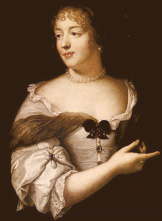
born on February 5, 1626, in Paris, France
died on April 18, 1696, at the Château de Grignan, France
French writer
400th birthday on February 5, 2026
330th anniversary of her death on April 18, 2026
Biography
The life of the most famous epistolière of the 17th century can be summarized quickly: orphaned at an early age, she spent a loving and sheltered childhood with her mother's family, received a thorough education, and at the age of 18 married the Marquis de Sévigné, with whom she had two children. The marriage was not a happy one; her husband frequently had affairs with other women before he was killed in a duel only seven years after the wedding.
From then on, the young widow spent most of her time at the Rochers estate in Brittany, and later in Paris, where the charming, witty, and extremely attractive marquise basked in her own social success and that of her beautiful daughter. Her daughter's marriage to the Count of Grignan, whom the bride had to follow to Provence, marked a profound turning point in her life.
The painful separation from her beloved daughter resulted in an extensive collection of letters (1,500 letters in 25 years, most of them to her daughter), which became the prototype of this literary genre. Their casual, conversational tone, their freshness, spontaneity, and naturalness were perceived as completely new and typically feminine. Witty, even critical observations about incidents at the court of the Sun King, gossip about theater performances, and clever thoughts about sophisticated literature caught the interest of her aristocratic friends, in whose salons the letters were read aloud.
They were not published until long after the author's death. They were then recommended especially to female readers, even though they contained bold statements such as the following famous threat to her son-in-law, who had impregnated her beloved daughter too often: “I will take your wife away from you. Do you think I gave her to you so that you could kill her, destroy her health, her beauty, her youth? I mean it.”
Madame de Sévigné was considered cheerful, sophisticated, even coquettish, but her letters also reveal an occasional tendency toward melancholy, a penchant for solitude, and sometimes agonizing questions about age and death. In the eyes of many she was the epitome of selfless motherhood. Yet one nevertheless wonders whether the rather reserved and cool-seeming daughter felt pressured by her mother, given all the effusive declarations of love, the intrusive advice and concerns about her health as well as the impatience with which her mother expected a response and reassurances. The mother-daughter relationship was more unstable, and in some years more precarious, than the legend would have us believe. Only after many conflicts did harmony prevail, with the death of the Marquise de Sévigné after exhaustively caring for her sick daughter then seeming to serve as the crowning apotheosis of maternal devotion.
(Text from 1995; translated with DeepL.com; edited by Ramona Fararo, 2026.
Please consult the German version for additional information, pictures, sources, videos, and bibliography.)
If you hold the rights to one or more of the images on this page and object to its/their appearance here, please contact Fembio.