-

Márta Mészáros
This biography is not yet available in English.
 You can find the German version here.
-
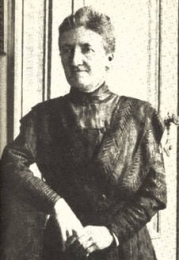
Marie Popelin
This biography is not yet available in English.
You can find the German version here.
-

Claire Sainte-Soline
This biography is not yet available in English.
You can find the German version here.
-

Elīna Garanča
This biography is not yet available in English.
You can find the German version here.
-

Liselotte Welskopf-Henrich
This biography is not yet available in English.
You can find the German version here.
-

born on September 20, 1831 in Berlin
died June 1, 1919 in Berlin
German writer and feminist theorist and satirist
Hedwig Dohm is one of the cleverest and wittiest feminists of the last 100 years. Some of her demands for women’s emancipation have still not been realized. Her critical analyses of works by patriarchal thinkers of her day are astoundingly clear-sighted and humorous, irreverently debunking their inane claims to power and theories “justifying” oppression.
Dohm was a very modern thinker. She saw that the so-called feminine social character has its roots in education and is not determined by biology. She demanded equal education and professional training for men and women and fought for women’s right to university education and women’s suffrage. Household chores and child-raising could be delegated to institutions to enable women to pursue professional careers. Financial independence of women would ‘ethicize’ marriage, since no women would be forced to marry simply for sustenance. According to Dohm, motherly love is not a natural instinct: “Maternalism must be stripped of the…read more
-

Born 19 September 1851 in Harburg near Hamburg
Died 5 January 1937 in Berlin
German women’s rights activist; pioneer in girls’ education
“Dear Mrs. Kettler, go back home and educate your children, if you have any. That’s useful. But spare the world your reforms; you’re making a terrible fool of yourself with them!”
This text appeared in a south German newspaper in 1903. The fearful “reforms” consisted in giving girls (as well as boys) the opportunity to complete high school and qualify for university study. Hedwig Kettler herself had attended only a girls’ finishing school, where she received a kind of semi-education designed to prepare her for a life as homemaker and mother.
On March 30, 1888 she founded, together with other women of similar views, the “Frauenverein Reform” (Women’s Reform Organisation), later called “Verein Frauenbildungsreform” (Organisation for Reform of Women’s Education), which aimed at implementing the demand for equal education of male and female. It was thanks to Kettler’s initiative that the first German college preparatory school for girls (Mädchengymnasium) was established in…read more
-

Born 25 August 1666 in Celle
Died 23 November 1726 at Ahlden Castle near Celle
Princess-Elector of Hanover
Sophie Dorothea was 16 when she was married to her cousin Georg Ludwig of Hanover. A payment of 10,000 thalers annually to father-in-law Ernst August, the signing over of all her property holdings and the prospect of taking over the rule of the principality of Celle permitted the Hanoverian court to overlook the dynastic blemish of her illegitimate birth. With the birth of a male heir a year later the Princess-Elector had fulfilled her duty, and her husband turned his attentions back to his mistresses.
Sophie Dorothea, born on 25 August 1666, was a fun-loving and attractive young woman. The only child of Duke Georg Wilhelm of Celle and “the Frenchwoman,” as Eleonore d’Olbreuse was derogatorily known in Hanoverian court circles, she was raised to be quite aware of her station and high value in the marriage market.
The Leine Castle in Hanover served as residence of the royal family. And here everyone knew everyone and observed everything. Spying, intrigues and romances made…read more
-

Anna Netrebko
This biography is not yet available in English.
You can find the German version here.
-

Oriana Fallaci
This biography is not yet available in English.
You can find the German version here.