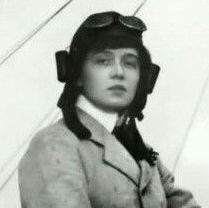
(Amelie Hedwig Beese, married name Boutard)
born on September 13, 1886, in Laubegast near Dresden, Germany
died on December 22, 1925, in Berlin, Germany
German aviation pioneer
100th anniversary of her death on December 22, 2025
Biography
Her dream had always been to fly a boat into the blue sky. She later succeeded in designing and constructing a flying boat, but when it was ready for takeoff World War I began…
Born Amelie Hedwig Beese in Laubegast near Dresden, she was encouraged by open-minded, wealthy parents who supported her in 1906 when she decided to study sculpture at the Royal Academy in Stockholm. Although her sculptures were widely admired, her passion remained ocean sailing and the desire to be as free as a bird; news of the world's first flight attempts fascinated her.
Returning to Dresden in 1910, Melli Beese gave up sculpturing and concentrated instead on shipbuilding and aeronautics. Her father, an architect, financed her flight training, which she began that same year at Johannisthal, the first German airfield to open and located in southeast Berlin.
It was a training course full of obstacles: just finding an instructor was difficult! In the end, Robert Thelen agreed to take her on as his first student. Since flying was only possible in absolutely calm conditions, patience was required. This was especially true for Melli, who was not considered at all or was only considered last for the practice flights. It was not so much a crash landing resulting in a protracted foot injury that made her path more difficult—it was the hostility of the pilots and engineers who would sabotage the flights of the “intruder in their territory” by tampering with the mechanics of the aircraft and the fuel tank. Technically gifted, persistent, and determined, Melli Beese prevailed: despite these “men's pranks”, she passed the exam with flying colors on her 25th birthday. She became the first German woman to hold a pilot's license—and after 114 men, Germany had its first woman pilot.
Perhaps, in addition to her desire to fly up into the blue sky, her persistence was also strengthened by her awareness of other women who had succeeded: the Frenchwomen Thérèse Peltier, Raymonde Laroche, Marie Marvinght, Marthe Niel, and the Belgian Hélène Dutrieu had obtained their pilot's licenses the year before. Perhaps she had also heard of the American aerial acrobat Blanche Stuart Scott, a member of a “flying circus” who performed daring stunts in the air.
During the Johannisthal Autumn Flying Week, which took place shortly after her exam, Melli Beese's colleagues tried once again to prevent her from taking off. But the airport director had already advertised the participation of Germany’s first woman pilot, sensing a big public success. Among 24 participants, she placed “only” 5th due to the machinations of her scheming fellow pilots. But she succeeded in setting two world records for women in terms of flight altitude and duration; public attention and praise then followed.
Around the same time, in October 1911, the first international women's flying competition took place in the United States, with Harriet Quimby, the first licensed American female pilot, as well as Blanche Scott and Hélène Dutrieu participating.
In 1912, Melli Beese opened the Flugschule Melli Beese GmbH (Melli Beese Flight School) with French pilot Charles Boutard, whom she married the following year. She designed a new curriculum that was more effective than the one that had previously been used. In addition to organizing and managing her flight school, she designed aircraft, built the Melli-Beese-Taube and, of course, continued to work on her flying boat, obtaining patents for her designs.
With the First World War already looming, only the large aircraft factories were supported by the state, and the pilots and engineers in Johannisthal were asked to either put their passion to work in the war effort or face a loss of orders, from which Melli Beese was excluded anyway.
She was ready to fly into the blue sky in Warnemünde in the flying boat she had finished building when war was declared on August 1, 1914. Her flying boat was destroyed. Her thriving factory and flight school were closed. She had become a French citizen upon marriage, and she and her husband were both arrested and interned as enemy aliens. When the war ended, they were penniless and seriously ill with tuberculosis.
Their plans for a new flight school and for filming a flight around the world failed due to lack of money. The sum they received as compensation after suing for the loss of their Johannisthal property was largely lost to inflation, and a book about their beginnings in Johannisthal was rejected. In 1925, Melli Beese crash landed while renewing her pilot's license. She had been living apart from her husband in a boarding house. On December 21, 1925, she shot herself, leaving behind a note with the words “Flying is necessary. Life is not.”
Her grave in the Berlin-Schmargendorf cemetery was declared an honorary grave in 1975; a flying club, a school, and streets were later named after her. “In the fight against many obstacles, she was victorious; she was broken by the militarization of aviation, nationalism, and the First World War.”
(Text from 2019; translated with DeepL.com; edited by Ramona Fararo, 2025.
Please consult the German version for additional information, pictures, sources, videos, and bibliography.)
Quotes
After her first solo flight, Melli Beese wrote:
For the first time, life and death were in my own hands—in a way that is immediate, unlike any other sport! ... I couldn't stop—again and again I let the machine rise, fall, rise again, swing to the left, in ever tighter curves. The Wright machine responded so wonderfully easily to even the slightest pressure on the controls…” (Gertrud Pfister, Fliegen - ihr Leben, p. 50)
Among the first female pilots, artists or at least women with artistic talent were disproportionately represented: Thérèse Peltier was a sculptor, as was Melli Beese; Raymonde Delaroche was an actress; Harriet Quimby and Marie Marvingt published texts in which they described their experiences as pilots. (Gertrud Pfister, Fliegende Frauen, p. 50)
If you hold the rights to one or more of the images on this page and object to its/their appearance here, please contact Fembio.