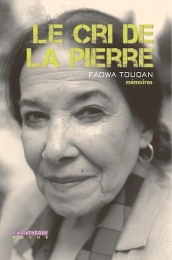
born: 1 March 1917 in Nablus, Palestine
died: 12 December 2003 in Nablus, Palestine
Palestinian poet
Biography
“This land, my sister, is a woman”
Born in Nablus, north of Bethlehem, surrounded by Israeli Settlements, Fadwa Tuqan died twenty three years ago, age 85. She died during one of the Palestinian uprisings against Israeli occupation, the Al-Aqsa Intifada. As of February 2026 Israeli forces are once again storming her beloved Old City of Nablus, imposing a violent siege against its unarmed Palestinian inhabitants.
About the powerless young Palestinian stone-throwers, she wrote:
They died standing, blazing on the road
Shining like stars, their lips pressed to the lips of life
They stood up in the face of death
Then disappeared like the sun. [Martyrs of The Intifada]
Hailed by Mahmoud Darwish as ‘The Poet of Palestine’, Tuqan’s resistance poetry remains as alive as ever. Such was the power of her verse, that Moshe Dayan compared it to ‘facing twenty enemy commandos’. Her words now speak to the new generation of Palestine activists defending their land, dignity, history, and culture. Her eight poetry collections are renowned throughout the Arab World.
Born to the wealthy Palestinian Tuqan family, known for their accomplishments in many fields, she was forced to quit school at 13 and kept virtually confined at home at her conservative father’s wishes. Fadwa’s mother was rejecting towards her and her father strict and distant. She formed a strong attachment instead to an aunt and uncle. One of her five brothers, the poet Ibrahim Tuqan, took responsibility for educating her, taught her English and introduced her to poetry. After he graduated from the American University of Beirut they lived together in Jerusalem until she went to Oxford University to study English and literature. [Another brother committed suicide and her eldest brother, Ahmad Toukan, was the former prime minister of Jordan.]
Her father’s death in 1948, coincided with the Palestinian Nakba ‘Catastrophe’, the violent displacement of more than 700,000 Palestinians and the destruction of over 500 Palestinian villages. The horror of this politicized Tuqan and her poetry became a powerful voice of resistance, a voice that drew on their deep attachment to the land.
At this time she also began to experience new personal freedom as a woman: “When the roof fell on Palestine’, she wrote, “the veil fell from the face of the Nablus women…young and educated women could mix freely with their male counterparts.” Her book, Alone With the Days (1952), focused on the hardships faced by women in the male-dominated Arab world. She compared Palestinian land to the strength of a woman: the bloodshed, trauma, and devastation endured all represent the strength that a woman has, whether it is exhibited through childbearing or raising the next generation of freedom fighters. She wrote movingly, in her memoir A Mountainous Journey (1990), about the restrictive nature of the patriarchy and its effect on her life as an Arab woman, describing how the women were hidden in the household ‘like frightened birds in a crowded coop’. She did not marry or have children.
Although there are other noteworthy Palestinian women poets, Tuqan was the first to dedicate her life to writing poetry. Her friend, the poet Mahmoud Darwish, said: “It is true that Fadwa wrote poetry about the Palestinian tragedy, and why would she not! But her subdued voice was different: it was the voice in love, in pain, the contemplative, and the lonely, which does not resemble another voice.” Reading a poem to him she said ‘‘I will not cry” but, he said, “she was crying like a dove”. Writing in free verse, she interweaved the individual voice with the national identity of Palestine, carrying the land in one’s soul. She bravely confronted both the patriarchal structures that sought to confine her and the occupational forces that aimed to erase her identity.
War and genocide is still being waged on her people who have had no respite in decades. A people who are at the mercy of a military that outweighs them in every measure.
Announcing her death, the Palestinian Authority described her as ‘the great poetess of Palestine, an innovative and original talent, a daughter of Nablus, the mountain of fire; daughter of Palestine, educator, fighter for justice, cultural icon, exceptional literary figure, winner of the Palestine medal.’
Tuqan depicted herself as a link in the chain of history:
I ask nothing more
Than to die in my country
To dissolve and merge with the grass,
To give life to a flower
That a child of my country will pick,All I ask
Is to remain in the bosom of my country
As soil,
Grass,
A flower.
She published eight collections of poems: “My Brother Ibrahim” (1946), “Alone with the Days” (1952), “I Found It” (1958), “Danos Love” (1960), “Before the Closed Door” (1967), “The Night and the Riders” (1969), “Alone on the Summit of the World” (1973), “July and the Other Anthem” (1989), and “The Last Toronda” (2000).
She also wrote two books, “Mountainous Journey: A Poet’s Autobiography” (1990) and “The More Difficult Journey” (1993).
She was the recipient of the International Poetry Prize in Palermo, Italy, as well as awards in Greece and Jordan, the Jerusalem Award for Culture and Arts from the Palestinian Liberation Organization in 1990, the United Arab Emirates Award, and the Honorary Palestine Prize for Poetry in 1996.
If you hold the rights to one or more of the images on this page and object to its/their appearance here, please contact Fembio.