Wikimedia Commons
born April 27, 1927 in Heiberger, Alabama
died January 30, 2006 in Rosarito Beach, Mexico
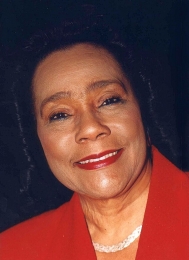
American Civil rights leader, wife and widow of Martin Luther King Jr, social activist, singer, founder of the Martin Luther King Jr. Center for Social Change
100th birthday on April 27, 2027
Biography • Literature & Sources
Biography
Coretta Scott King was a remarkable woman who partially subordinated her musical career to support her husband’s role as leader of nonviolent opposition to white supremacy. Yet she also played an important part in that struggle herself; her Freedom Concerts in particular raised money for the movement and merged activism with the performing arts, and she joined with her husband in many marches and protests. She leveraged her contacts (such as Robert Kennedy and Presidents Kennedy and Johnson) to gain financial and political support. Following her husband’s assassination in 1968 she expanded her activism to include women’s and gay and lesbian rights as well as the struggles for racial equality and against poverty and apartheid. She founded the Martin Luther King Jr. Center for Nonviolent Social Change, a social and cultural institution in Atlanta, Georgia, in 1968.
Coretta Scott, the third of four children, was born at home in Heiberger, Alabama, attended by her paternal great-grandmother, a former slave, as midwife. Her musically talented mother played piano in church, drove a school bus, and helped her husband in his business. Her father was one of the first Blacks to own a vehicle; he had a number of businesses, including a clothing store, a general store and a lumber mill which was burned down by angry whites. Both parents were strong believers in education for their children. Coretta quoted her mother as having said, “My children are going to college, even if it means I only have but one dress to put on.” [King, Coretta Scott (Fall 2004). “Address, Antioch Reunion 2004”. The Antiochian. Archived from the original on May 1, 2007. Retrieved September 10,2007.]
After attending a one-room elementary school, Coretta excelled at her segregated high school, graduating as valedictorian of her class. She went on to study at Antioch College in Yellow Springs, Ohio, where her older sister Edythe had been the first black student admitted. Here she majored in elementary education with a minor in music and became involved in peace activism and civil rights, joining the NAACP.
She left Antioch when she won a scholarship to study voice and piano at the New England Conservatory of Music in Boston. Here she was introduced by a friend to Martin Luther King, Jr, who was studying systematic theology at Boston University. Finding her his intellectual peer, he was immediately determined to make her his wife. She eventually agreed, and the two were married in 1953. She showed her independent spirit by removing the vow to obey her husband from the ceremony, but she stood by her husband in spite of his marital infidelities. The couple would have four children.
The Kings moved to Montgomery, Alabama, where Martin had been appointed pastor of the Dexter Avenue Baptist Church. From December 1955 to December 1956 the Black community conducted a boycott of the segregated public transit system, which earned Martin and the emerging civil rights movement nationwide attention – and also angry attacks from Montgomery whites. When the Kings’ house was firebombed Martin urged a nonviolent response to his outraged followers. Because of the couple’s activism, Coretta had to put up with many threats and acts of aggression throughout her life.
After Martin’s assassination on April 4, 1968, Coretta led an estimated 42,000 people for the Memphis Sanitation Workers’ Strike march in honor of her husband. “We are concerned about not only the Negro poor, but the poor all over America and all over the world,” she told the throng. She would continue her campaign against poverty, racism and war for the rest of her life, urging women in particular to join the struggle. In 1969 Coretta published My Life with Martin Luther King, Jr. and traveled to Great Britain, Germany, Holland, France, Spain, Sweden, and Italy. She carried the message of nonviolence: “The insight I gained there into the ways other nations were institutionalizing my husband’s vision inspired me.” [Coretta Scott King, My Life, My Love, My Legacy, 2017] She publicly supported Hugo Chavez, the Latino-American civil rights leader who had been arrested in 1970 during the Lettuce Boycott, defending his campaign to address farm workers’ rights through mass strikes and boycotts. As co-chair of the National Committee for Full Employment and the Full Employment Action Council Coretta met with almost every U.S. Senator and countless House members on behalf of jobs legislation; the landmark Full Employment and Balanced Growth Act was passed in 1978. “The drive for full employment was the bridge that brought me to an understanding of the art of lobbying. To be successful, we had to build strong coalitions. And I began to see that one of my strengths was as a coalition builder.” (Coretta Scott King, My Life, My Love, My Legacy, 2017)
In the decade after her husband’s death, Coretta worked tirelessly to build a memorial to his legacy of nonviolent activism, urging a federal holiday in his honor (finally achieved in 1983). She spent the seventies through the early eighties designing and implementing a documentary center to house Martin’s speeches, writings and other similar materials. It was later renamed the Martin Luther King Jr. Center for Social Change and under her leadership grew to include an extensive community center that boasted a gymnasium, a game room, a library, community services, a fountain, a natatorium, and an early learning center. Through extensive programming and community-based engagement, The King Center disseminated nonviolence training to communities around the world.
Coretta’s funeral in 2006 was attended by over 10,000 people, including global leaders and Presidents George W. Bush, Bill Clinton, George H.W. Bush, and Jimmy Carter. Future President (then Senator) Barack Obama and his wife Michelle were also in attendance.
Literature & Sources
Bagley, Edythe Scott (2012). Desert Rose: The Life and Legacy of Coretta Scott King. University of Alabama Press. ISBN 978-0817317652.
Coretta Scott King. Wikipedia (English version is very thorough.)
King, Coretta Scott (1969). My Life with Martin Luther King, Jr. Puffin. ISBN 978-0140368055.
King, Coretta Scott (2017). Coretta: My Life, My Love, My Legacy. Henry Holt
King, Coretta Scott: Mein Leben mit Martin Luther King. Mohn, Gütersloh 1985, ISBN 3-579-03643-2.
McCarty, Laura T. (2009). Coretta Scott King: A Biography. Greenwood Biographies. ISBN 978-0313349812.
The King Center. Timeline https://timeline.thekingcenter.org/timeline/the-king-center/
(Detailed biography of Coretta Scott King with many links)
Vivian, Octavia B. (2006). Coretta: The Story of Coretta Scott King. Minneapolis: Fortress Press.
If you hold the rights to one or more of the images on this page and object to its/their appearance here, please contact Fembio.