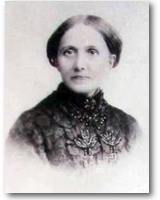
(Franziska Ernestine Rosaura Nietzsche, neé Oehler)
born on February 2, 1826, in Pobles near Lützen, Saxony
died on April 20, 1897, in Naumburg
wife of a German pastor; mother of Friedrich and Elisabeth Nietzsche
200th birthday on February 2, 2026
Biography
Hardly any other woman has been as misrepresented in academic literature as Franziska Nietzsche, the mother of Friedrich Nietzsche. She is reported to have had a cold and loveless relationship with her two children and to have subjected them to a strict, Christian revivalist upbringing while spending hours every day on her knees, muttering prayers and Bible verses to herself. Scholars surmised that Friedrich and Elisabeth, strong-willed and striving to make their marks in the wider world, were driven by the need to dissociate themselves from their pious mother when they fled from the narrow confines of their home into the world of the mind (and imperialism).
Reputable scholars continue to spin this popular tale. Admittedly, the remarks of Franziska’s own children seem to offer evidence in support of such an interpretation – Friedrich referred to his mother as a “poisonous worm” and “a machine out of hell” while Elisabeth saw her as a “woman lacking character.”
Yet a careful examination and evaluation of the multitudinous documents available on Franziska Nietzsche reveals a different and more nuanced picture. She came from a cosmopolitan, fun-loving pastor's family. Her father, an enlightened man, believed that his duties as a pastor included promoting the material well-being and education of his parishioners. Her mother was in charge of the large household and it was thanks to her good economic management that the financial means necessary for the sons' education were available. Further education or training was not an option for girls; the daughters enjoyed the dance parties and summer excursions typical for young ladies from good families and were otherwise only expected to marry as soon as possible in order to be provided for.
Franziska succeeded in finding a suitable match, which was also a love match on both sides. However, her marriage to the young pastor Carl Ludwig Nietzsche placed her in a completely different intellectual world. Her husband belonged to the revivalist movement, and its dramatic preaching culture, fervent piety, and reactionary political stance differed greatly from the cheerful world of her parents' home. Just a few years after the wedding, he fell seriously ill, and died in 1849.
Left without support, with two small children and no means of earning a living, Franziska then faced years of dependence on her better-off mother-in-law and on occasional charitable donations. Franziska retained her zest for life and an openness to the world, cultivating her circle of friends and family. She succeeded in providing her children with a good education, in accordance with their gender.
Friedrich became a professor of classical philology in Basel at a young age, while Elisabeth founded the Nueva Germania colony in Paraguay together with her husband Bernhard Förster. Both claim a place in German cultural and intellectual history, notwithstanding Elisabeth's inglorious blindness to the Nazi terror.
With Friedrich suffering from mental confusion more and more often, his mother took him into her home. Elisabeth increased his fame through tireless journalistic activity and laid the foundation for his international reputation by collecting all of his correspondence and writings, while Franziska cared for him patiently and lovingly until her death. Franziska’s letters to Friedrich's loyal friend Franz Overbeck, in which she recounted her laborious service to her sick son, are an authentic testimony to true Christian humanism and among the finest examples of bourgeois German epistolary culture.
(Text from 2000; translated with DeepL.com; edited by Ramona Fararo, 2026.
Please consult the German version for additional information, pictures, sources, videos, and bibliography.)
Quotes
Looked through Nietzsche's mother's letters until late. Moved and immersed in thought. (Thomas Mann)
I loved my mother very much because she is good. (Friedrich Nietzsche)
A nameless sorrow often pierces my soul, but I must thank the All-Merciful One from the bottom of my heart for keeping me healthy. What would become of the poor, poor child who benefits so much from his mother's love… (Franziska Nietzsche)
If you hold the rights to one or more of the images on this page and object to its/their appearance here, please contact Fembio.