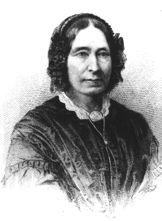
(Johanna Friederika Henriette Katharina Davidis)
born on March 1, 1801, in Wengern an der Ruhr
died on April 3, 1876, in Dortmund
German cookbook author
225th birthday on March 1, 2026
150th anniversary of her death on April 3, 2026
Biography
She has been referred to as the “inventor of the cookbook” and was said to have been the first to use the phrase “man nehme” (take) when writing up recipes. She would have rejected both attributions and referred to two of her maxims: “Wherever possible, it’s simply preferable to be accurate” and “Modesty becomes a woman.” Davidis spent eight years collecting recipes for her first cookbook, trying out most of them herself. She experimented with her recipes on an estate in Wengern, where she was reported to have cooked her way through the entire pantry of a four-horse carriage farm.
Henriette Davidis was born in 1801 as the tenth of 13 children in a pastor's family in Wengern an der Ruhr. She moved to Dortmund in 1856, later making a name for herself far beyond the city’s borders as an author of cookbooks and educational guides. She brought her life experience as an unmarried woman (she was engaged twice, but both fiancés died), a governess, and the daughter of a large family to her writings. It was the fate of her mother that led her to devote herself to perfecting the art of housekeeping: “My mother ... was completely ignorant of housekeeping, she did not even know the names of farming tasks, which then led to all kinds of embarrassing situations when fulfilling her duties as a pastor's wife.”
We do not do Henriette Davidis justice if we regard her merely as the “doyenne of the culinary arts.” The Praktisches Kochbuch (Practical Cookbook) of 1845 was part of a comprehensive education and training program that she had developed for girls. Her guides were all informed by her firmly established, religiously influenced, and deeply conservative view of women. Each unit seemed to build on the previous one, and together they formed a modular system of educational guides: girls first read Puppenmutter Anna (Doll Mother Anna, 1858) and Puppenköchin Anna (Doll Cook Anna, 1856) as children, before being given Der Beruf der Jungfrau (The Work of a Virgin, 1857) to read when they were older. After marrying, they received a cookbook and guide to housekeeping, completing their training as young housewives with Die Hausfrau (The Housewife).
Davidis believed the main responsibility of the housewife was to “create prosperity and independence” – for the husband.
Henriette Davidis has been asserted to have been “one of the most important women of the 19th century” by proud city officials in Dortmund. However, this accolade is as unnecessary as other superlatives. After all, she published a large number of widely read books, including a bestseller – no easy feat for a woman of her time. That is indeed something that is truly remarkable.
(Text from 2000; translated with DeepL.com; edited by Ramona Fararo, 2026.
Please consult the German version for additional information, pictures, sources, videos, and bibliography.)
Quotes
Cooking should not be considered a minor matter, if only for the sake of health. Every daughter—including those from the upper classes—should become sufficiently familiar with it so that she can take charge as a housewife or, where circumstances do not require this, be able to supervise the work in the kitchen so that she does not fall too heavily into the hands of her servants. (Henriette Davidis, Practical Cookbook, 1845).
If you hold the rights to one or more of the images on this page and object to its/their appearance here, please contact Fembio.