

Fembio Special: Women from Potsdam
Marie Luise Kaschnitz
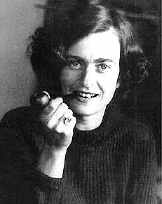
(Baroness von Kaschnitz–Weinberg, née von Holzing)
born on January 31, 1901, in Karlsruhe, Germany
died on October 10, 1974, in Rome, Italy
German writer
125th birthday on January 31, 2026
Biography
A border crosser, always searching for her own place in the world, constantly looking into the abyss of everyday horror, often despondent, but never completely giving up.
In her last essay she also weighed the possibility of “salvation through imagination.” Three special places, intertwined in her poetry and prose, define the landscape of her life while she journeyed through life, always “searching for home (love).” After attending school in Berlin and Potsdam, she found a perfect home in the village of Bollschweil in Baden during the First World War. She worked in a bookshop in Rome, and it was in Rome where she met archaeologist Guido von Kaschnitz-Weinberg. She married him in 1925, gave birth to their daughter Iris Costanze in 1928 and enjoyed over thirty productive years of security in the marriage. Even when she was elsewhere, the Eternal City remained a place of memory and longing. The antithesis to Rome was the “ugly city” of Frankfurt am Main. Time and again, this woman, who felt fundamentally out of place in the world, searched for a safe place: “Where have we come from?” and “Where am I to go?”
Two turning points in her life brought about changes in the content and form of her literary endeavors: the experience of World War II and the death of her husband in September 1958. Leaving behind the death wish triggered by the second, greater existential crisis, she asserted: “For me, old age is not a dungeon, but a balcony from which one can see further and more clearly.” Kaschnitz reduced her language from the pathos of her earlier works to sober description. Despite her doubts, she remained “still open” until the end. She never stopped wanting to see, hear, and communicate. Like the photographer behind the hedge in her famous poem Hiroshima, she wanted to be “the eye of the world” as a writer, “at home nowhere anymore and everywhere.” At the end of her life and in her last book, however, she appeared to be resigned, writing at the end of Orte in 1973 that “my feet leave no trace.”
Marie Luise Kaschnitz died on October 10, 1974, in Rome and was buried in Bollschweil.
(Text from 1993; translated with DeepL.com; edited by Ramona Fararo, 2025.
Please consult the German version for additional information, pictures, sources, videos, and bibliography.)
Quotes
The extreme is the limit, beyond which lies madness or despair, and I didn't want to go there. Later, when writing, it was the same… Probably I just wanted to live, not alone, rather with love, which requires balance, a sense of floating and letting yourself be carried, at least for a woman. Those who take the world upon their shoulders are torn down; alas, sometimes you can't control it and it's already at your neck and you fall down and away from everyone else.
If you hold the rights to one or more of the images on this page and object to its/their appearance here, please contact Fembio.
