
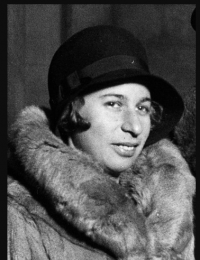
wikimedia commons; Robert Sennecke
(Clara Eleonore Stinnes(-Söderström))
born on January 21, 1901, in Mülheim an der Ruhr, Germany
died on September 7, 1990, in Björnlunda, Sweden
German-Swedish racing driver; farmer; together with her driver and later husband, she was the first person to circumnavigate the globe by car
125th birthday on January 21, 2026
Biography
Clärenore Stinnes caused an international sensation from 1927 to 1929 when she was the first to drive around the world. Self-confident, athletic, and cosmopolitan, she wanted to travel and to see the world with her own eyes. “I'm setting off to the east and returning from the west.” The seemingly impossible became reality, even though there were hardly any roads suitable for cars outside the major cities in the United States and in Europe, and gas stations were rare. She was determined to prove what a German-built car could endure; her determination was in part a result of the upbringing she had enjoyed as a child and in part due to her frustration that many countries in the 1920s were choosing to avoid doing business with Germany. Above all, however, she was a bold and fearless racing driver.
Clärenore Stinnes grew up as the eldest daughter in a distinguished family in Mülheim an der Ruhr. Her mother, Cläre Stinnes-Wagenknecht (1872-1973), ran the household, while her father, Hugo Stinnes (1870-1924), was one of the Ruhr region's major industrialists and politically active as a DVP member of the Reichstag. Although the family was wealthy, the seven children received a relatively spartan upbringing and their independence was encouraged. Clärenore, the self-confident daughter, demanded from her parents that they treat her exactly the same as her three brothers.
She did not fit the classic mold of a “daughter from a good family.” “I grew up in freedom and playing with boys, and I felt that school was nothing more than an oppressive constraint. Soldiers, cannons, castles, and trains were my toys when the weather was bad. I often had to hear that I didn't know how to behave like a girl and was even worse than the boys.”
Clärenore Stinnes, far removed from the political unrest in the Ruhr region, chose to start working on one of her parents' farms after finishing school. She loved being outdoors, taking care of the animals and seeing to everything else associated with the farm — she especially enjoyed riding horses. Driving was another passion; she got her driver's license at 18. She then traveled through South America for nine months on behalf of her beloved father to report on his properties there (shipping lines, farms, forests). After that, she worked as a secretary for him in Berlin and planned on pursuing a career in his company. However, life took a completely unexpected turn when he died in 1924 at the age of 54 and her mother took over the management of the company. Convinced that it was time for her daughter to marry and start a family, she excluded Clärenore from the company.
The transformation
Clärenore drew the necessary conclusions and distanced herself from her family. She soon transformed herself into a self-confident, modern woman who had short hair and preferred to wear a suit and tie. In the fall of 1924, she was invited by Dinos Autowerke, a Stinnes subsidiary, to take part in a car rally in Essen. The sport suited her: she finished third. Clärenore Stinnes: “From then on, I risked my life almost every weekend to win a car rally.” She took part in the most difficult mountain rallies in Austria and Switzerland, and soon developed into a successful racing driver. She won 17 races in her class, becoming a formidable competitor for the men. In 1925, she was the only woman to win the All-Russian Trial Run that covered 2,600 km across western Russia. It was during this trip that she came up with the idea of circumnavigating the world by car. She wanted to prove that countries could forgo the boycott given the high quality of German products.
Through two worlds by car
Clärenore Stinnes convinced several companies in the automotive industry to provide not only a standard Adler 6 sedan (50 hp, 6 cylinders, max. 120 km/h) and an Adler truck for supplies and tools, but also spare parts, fuel, two mechanics, and 100,000 Reichsmarks. Foreign Minister Stresemann issued her with a diplomatic passport, which gave her access to German embassies worldwide, where she could store supplies of oil and gasoline in advance. With this document, she was able to obtain visas for 23 countries in Berlin. As the journey was also to be documented on film and in photographs, she needed to be accompanied by a professional. Shortly before the start, she chose the Swedish filmmaker Carl-Axel Söderström (1893-1976); he had already made an international name for himself with silent films and she considered him artistically and athletically up to the challenge.
In May 1927, Stinnes set off with Söderström and the mechanics from Frankfurt am Main. Their journey first took them across the Balkans and through Turkey to Damascus in Syria. They crossed the desert towards Baghdad, then traveled through the Caucasus to Moscow and on to China through endless mud and dangerous Siberian ice fields. The two mechanics bailed out in Russia, but Stinnes and Söderström mastered the multitude of other natural obstacles that followed, i.e. deserts, mountain ranges, swamps, and all kinds of extreme weather conditions. They also survived numerous breakdowns, accidents, thirst, illness, hunger, and exhaustion as well as encounters with drunks, wolves, robbers, and authoritarian local officials. But there were at least as many positive encounters: with princes, with Chinese nobility, with Henry Ford and with Herbert Hoover, the President of the United States. Above all, they met “people like you and me” on each continent.
Clärenore Stinnes: “...I always attracted the attention of women. Whether in Asia Minor or China, whether it was journalists in the United States or farmers in the interior of Peru, age and marriage were always the focus of their questions. But the Indian women of Peru were kind, despite their thirst for knowledge and their lack of understanding of my single status, and when I left them, they said, ‘Take care, nice girl! Don't forget us!’”
Great cinema
In June 1929, just over two years after setting off, Clärenore Stinnes and Carl-Axel Söderström reached Berlin, where they were cheered enthusiastically on the AVUS, the precursor to the autobahn. They had driven 46,758 km in the standard sedan. Except for the transmission, they had replaced almost every part in the sedan once or several times on their own. In the same year, Clärenore Stinnes' travel diary Im Auto durch zwei Welten (Through Two Worlds by Car) was published, wonderfully written and still an impressive document in many ways today. In Berlin, time had not stood still between 1927 and 1929, and silent films had given way to talkies. Söderström and Stinnes therefore produced a documentary film, which they accompanied with music and their own voice-over commentary. It was subsequently shown in major cinemas across Germany before finding its way abroad.
In December 1930, Clärenore Stinnes and Carl-Axel Söderström married and settled in Sweden, where they took over the management of a farm belonging to the Stinnes family. They raised three children of their own and fostered other children as well. After the family farm was expropriated following the Second World War, they moved to Björnlunda, where they ran a farm until the 1960s. Clärenore Söderström became a distinguished leader in the Swedish Red Cross. Even at an advanced age she continued to enjoy driving long distances in a Volvo.
(Text from 2021; translated with DeepL.com; edited by Ramona Fararo, 2025.
Please consult the German version for additional information, pictures, sources, videos, and bibliography.)
If you hold the rights to one or more of the images on this page and object to its/their appearance here, please contact Fembio.