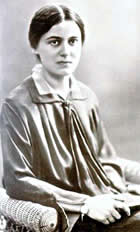
born on October 12, 1891, in Breslau
murdered on August 9, 1942, in Auschwitz
German philosopher, Christian martyr, saint
135th birthday on October 12, 2026
Biography
“What characterizes saints is a distinctive personality” (Régine Pernoud). This is particularly true of the Jewish philosopher and Carmelite nun Edith Stein, who was canonized in 1998. Her life was marked by the tension between opposites and was dedicated to the quest for a synthesis between Judaism and Christianity, between philosophy and religion, and between mystically experienced faith and active charity.
As the youngest of six siblings, Edith Stein grew up in a Jewish family. After her father’s death, her mother single-handedly kept the debt-ridden lumber business afloat and ensured that all her children received a good education. She was a devout Jew, while her favorite child, the headstrong, highly gifted Edith, consciously renounced the Jewish faith at an early age and described herself as an atheist.
After graduating from high school, Edith was given her mother’s permission to study history and German language and literature in Breslau, where she completed her studies in 1915 with the state examination. However, her interest lay primarily in philosophy. She transferred to the University of Göttingen to attend lectures on phenomenology by the famous philosopher Edmund Husserl. She became his star pupil and assistant, and also earned her doctorate under his supervision. However, as a woman she was denied the opportunity to obtain her habilitation and thus to pursue an academic career. This bitter experience contributed to her commitment to women’s rights. From 1922 to 1933, she worked as a teacher and lecturer. She discussed ideas with friends and enjoyed going on hikes with them, yet she revealed little about herself and was considered reserved.
Her passionate search for truth also led her to questions of religion, to which she ultimately found definitive answers in Christianity. The works of Thomas Aquinas and Teresa of Ávila fascinated and influenced her so much that she decided to be baptized in 1922, much to her mother’s consternation. From then on, it was her ardent desire to be admitted to the strict Order of Carmel, which she initially denied herself out of consideration for her mother and because spiritual advisors urged her to continue her scholarly work. Beginning in 1933, the year the Nazis seized power, she was no longer allowed to publish; her work as a lecturer was also prohibited. The time thus seemed to have arrived for her to devote herself entirely to her faith and to enter the Cologne Carmelite convent as a nun. In 1935, she took her first vows and received the name she had chosen for herself: Teresia Benedicta a Cruce. Her family was horrified and felt betrayed during this time of persecution and extermination. In truth, Edith had never stopped feeling a sense of belonging to the Jewish people. She tried—in vain—to persuade the Pope to issue an encyclical against the persecution of the Jews.
When her presence in the Cologne convent began to endanger others there, she fled to the Echt Carmel in the Netherlands. Even there, her life was no longer safe. After courageous Dutch bishops had a pastoral letter against the persecution of Jews read from the pulpits, she was arrested by the Gestapo along with many other Dutch Jews, deported to Auschwitz, and murdered in the gas chamber.
Until the very end, she stood by her desperate fellow prisoners. She herself called the death she awaited with such calm a sacrifice of atonement for her people.
(Text from 2001; translated with DeepL.com; edited by Ramona Fararo, 2026.
Please consult the German version for additional information, pictures, sources, videos, and bibliography.)
Quotes
When the mind dares to go to the very limits of its capabilities, it reaches its own boundaries. It sets out to find the highest and ultimate truth, and discovers that all our knowledge is fragmentary.
Whoever seeks the truth seeks God, whether they realize it or not.
It is a long way from the complacency of a “good Catholic” who “fulfills his duties,” reads a “good newspaper,” “votes correctly,” and so on, to a life guided by God’s hand, with the simplicity of a child and the humility of a tax collector. But whoever has once walked that path will never turn back.
If you hold the rights to one or more of the images on this page and object to its/their appearance here, please contact Fembio.