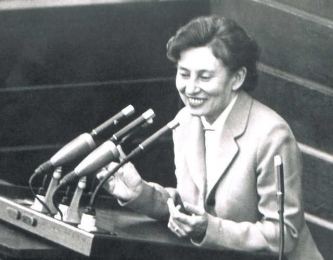
(Dr. iur. Emma Sophie Elisabeth Schwarzhaupt)
born on January 7, 1901, in Frankfurt am Main, Germany
died on October 29, 1986, in Frankfurt am Main, Germany
German politician (CDU); first female minister of the Federal Republic of Germany
125th birthday on January 7, 2026
Biography
Elisabeth Schwarzhaupt coined a phrase that is unfortunately still valid today: “Society is changing – the legislator reacts – often too late – as a man.”
She was one of the women who, holding public office during the Weimar Republic and in the early days of the Federal Republic of Germany, campaigned for the reform of family law in order to improve the legal status of women (after 1949: in accordance with the German constitution, Grundgesetz).
Schwarzhaupt grew up in Frankfurt am Main in a liberal family. She studied law from 1921 and, after passing the required state examinations, worked as a judge from 1931. As a working woman, she experienced time and again the paternalism and discrimination against women that was cemented in law at the time – and this was to have a lasting influence on her political thinking.
However, according to fascist ideology, women did not belong in higher public offices, and thus in 1933 she was banned from working as a judge. Later she was to remark that “... following the issuance of at least six decrees, Dr. Nadler, Dr. Freisler, and Frick commented on the employment of women in the judiciary. These decrees represent an amusing dance around the issue by the leading National Socialist guardians of the law in response to the Führer’s terse pronouncement that women cannot be judges. ... I have described this interpretation of the law with regard to women in some detail because it represents the grotesque and persistent practice to refer to a certain traditional role model for women depending on whether women’s participation in the labor market would mean the men looking for jobs would face stronger competition or not.”
Despite these difficult conditions, she earned her doctorate and worked at the headquarters of the German Association of Pensioners from 1934 to 1936, and from 1936 to 1953 for the Protestant Women's Work in Germany, where she continued on a volunteer basis from 1947 onwards.
In 1953, she became a member of the German Bundestag (CDU parliamentary group) and in 1961 she became Minister of Health. As the first woman minister in the Federal Republic, Schwarzhaupt soon became the preferred contact for any and all “women's issues.” It is thanks to her that several reforms were successfully legislated, often with the support across party lines of women in rival political parties. The most notable legislation improved the legal status of mothers and children born out of wedlock.
After leaving parliament, she was chairwoman of the German Women's Council from 1970 to 1972 and chairwoman of the German Association of Women Academics from 1970 to 1974.
(Text from 2000; translated with DeepL.com; edited by Ramona Fararo, 2025.
Please consult the German version for additional information, pictures, sources, videos, and bibliography.)
If you hold the rights to one or more of the images on this page and object to its/their appearance here, please contact Fembio.