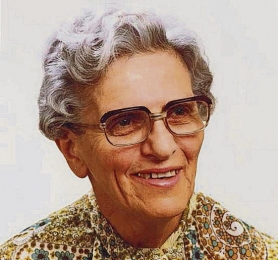
Schweizerisches Sozialarchiv, Zürich
born on May 2, 1901, in Ulm, Germany
died on June 8, 1988, in Wil, St. Gallen, Switzerland
Swiss lawyer and feminist
125th birthday on May 2, 2026
Biography
Women in Switzerland did not obtain the right to vote and stand for election until February 7, 1971 when the Federal Constitution was accordingly amended. And another 19 years would pass before women in every corner of Switzerland were actually able to exercise these rights; the last of several Swiss cantons that continued to deny women their constitutional rights had to be forced to desist by the Supreme Court of Switzerland in 1990.
The constitution was successfully amended in 1971 primarily thanks to the efforts of the Swiss Association for Women's Suffrage, of which Lotti Ruckstuhl was president from 1960 to 1968.
Lotti Ruckstuhl grew up in South Africa, where her mother introduced her to the issue of women's suffrage when she was still a child. She moved to Switzerland, studied law in Zurich, but she soon realized that only people with active citizenship (i.e., citizens with voting rights) were promoted in the court system – in other words, only men. She then chose a different profession, becoming politically active in the late 1940s when she joined the Swiss Association for Women's Suffrage.
The first federal referendum on women's suffrage took place in 1959. Many Swiss women, including women in rural areas, were themselves opposed to suffrage (campaigns later even included slogans such as “Men, help us women against total politicization!” and “Leave us out of it!”), thus contributing to the defeat.
In 1960, Lotti Ruckstuhl became president of the association and launched a determined campaign that included press work, the organization of “women's panels” (discussion forums) and participation in the Foundation for Civic Education and Training (SAFFA).
In 1962, Switzerland joined the Council of Europe, even though its statutes require compliance with human rights and respect of fundamental freedoms, which of course include the right to vote. Lotti Ruckstuhl and the board of her association protested in vain. In 1963, Switzerland's accession to the European Convention on Human Rights was postponed for precisely these reasons. It would be several more years before voting rights were achieved. Lotti Ruckstuhl remained president until 1968, devoting her energies to overcoming other injustices in Swiss legislation: She achieved easier naturalization for the children of Swiss women married to foreigners, ensured that the other spouse must agree to a payment plan, and that birth defects are included in disability insurance. In 1978, she received the Ida Somazzi Prize “in recognition of her extraordinary commitment to human rights in the broadest sense.”
(Text from 1990; translated with DeepL.com; updated and edited by Ramona Fararo, 2026. Please consult the German version for additional information, pictures, sources, videos, and bibliography.)
If you hold the rights to one or more of the images on this page and object to its/their appearance here, please contact Fembio.