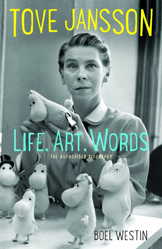
(Tove Marika Jansson)
born on August 9, 1914, in Helsinki, Finland
died on June 27, 2001, in Helsinki, Finland
Finnish painter, cartoonist, graphic artist, comic artist, illustrator, writer, playwright, and set designer
25th anniversary of her death on June 27, 2026
Biography
“Studio” was for her another word for “home”, as both her parents were artists: her father was the Finland-Swedish sculptor Viktor Jansson, known as Faffan, and her mother was the illustrator Signe Hammarsten, originally from Sweden and known as Ham. Tove Jansson and her two younger brothers grew up in an environment where the most important thing in life was creating art. Work and home life were never separate in her family; something new was always being created.
She developed a sort of love-hate relationship with her father—an anti-Semitic patriot—because for a long time their societal views were so far apart that they found it impossible to understand each another. In contrast, she remained very close to her mother throughout her life. It was her mother who was her first teacher, and it was on her lap that Tove learned to draw. The maternal side of her family also included talented storytellers—Wilma Lindhé, the sister of Ham’s father, was a successful author in the 1880s whose works had addressed the difficulties women faced while juggling both family life and a career.
Tove Jansson began working as an illustrator at a young age and her first drawings were published when she was just 14 years old. A year later, she was already creating illustrations for various newspapers, and her first comics were also published at that time.
She hated school. For the most part she found sitting in the classroom boring, at times she even felt that it was like being imprisoned. At 16, she was allowed to drop out of school and to study art at the University College of Arts, Crafts and Design in Stockholm where from 1931 to 1933 she focused on training as a book illustrator and commercial artist. Since she found this specialization uninspiring in itself, she consciously developed her skills in other areas as well, such as painting, especially decorative painting. She was to later profit from these skills when working on the many monumental decorative paintings she created for kindergartens, restaurants, and schools across Finland.
Jansson was already very ambitious as a girl and young woman. She wanted to tell and to write stories; she wanted to see them published and read; she wanted to support herself and her family.
After completing her studies, she returned to Helsinki, where she attended the painting class at the Graphic School of the Finnish Academy of Fine Arts intermittently from 1933 to 1936. On her first trip to Paris, she discovered the Impressionists, who had a lasting impact on her. She studied Matisse in particular, whom she greatly admired, as well as the works of Suzanne Valadon. During a second stay in France in 1938, she tried out several art schools before deciding on the Atelier d'Adrien Holy. She wanted to go her own way—alone and free, as was her ideal—and to find her own style. During a stay in Brittany, in one of her most productive periods, she painted primarily beach scenes. She then visited fascist Italy, traveling quickly and eager for new impressions, well aware of the threat of war. Already in 1933, she began writing short stories—some were published in Swedish, others in Finnish. She also wrote regularly for various newspapers about her travels.
After returning to Finland, she actively participated in events within the art scene, and her works were featured in numerous small and large exhibitions. She was soon regarded as a bold and promising young talent.
The war years were the most difficult years of Tove Jansson’s life. Although she wished she were no longer alive, this period turned out to be exceptionally productive. Words played a major role, as always; she experimented with new forms of writing. In addition to selling her paintings, she had a steady income at the time as an illustrator of art postcards and various newspapers. The highly regarded graphic artist was considered Finland’s best cartoonist. Starting in 1929, Tove Jansson drew and wrote for the liberal magazine Garm—for which her mother had also worked—and took on an ever-increasing share of the illustrations. These were primarily political drawings; she boldly interpreted the mood of her time, demonstrating great courage in the process. Many others held back, fearing a possible occupation by fascist Germany or the Soviet Union. In contrast, she revealed in her illustrations her anti-fascism, pacifism, and deep hatred of war, —even though the glorification of war was the official state policy. As a result, the newspaper was repeatedly threatened by censorship and constantly ran the risk of being charged with defamation.
In addition to her work as an illustrator, Tove Jansson continued to paint; during the war, she mainly created floral still lifes, and it was during this time that she created the characters who would later make her world-famous: the Moomins. At first, it was just a little flourish she added to her drawings under her signature—but her first Moomin book was published as early as 1945, with the second following a year later. While she had initially invented the stories for herself—creating an alternative world where she could flee from the desolation of everyday wartime life and experience a brief refuge—she began writing her first Moomin comics in 1947 at the request of her then-partner Atos Wirtanen, the editor-in-chief of the newspaper Ny Tid. In 1954 they began appearing in the London Evening News, embarking on a journey to global success. Although Tove Jansson had hoped to make a name for herself as a painter, it was her Moomins that made her world-famous. At the height of their popularity, the comics were published simultaneously in 40 countries, reaching some 20 million readers. She was considered a unique talent due to the seamless integration of text and image in her comics. To this day, new editions of the books, comics, and plays continue to be released worldwide; there are various film adaptations, and even an opera. An entire Moomin industry has emerged.
The Moomins represent a familiar, safe, and homey world. The stories deal with coping with fear and the simple things in life, which is essentially shaped by the sea, storms, steep cliffs and ravines, flowers, and the impenetrable forest. She did not pursue any educational agenda with them. While the first five volumes can still be read as children’s books—mastering challenges, overcoming fear, and returning home to a safe world—Jansson’s primary focus in the last three volumes was on the inner lives of the characters, thereby appealing more to adult readers. In all of the volumes tolerance and kindness form the basis for how the characters interact with one another.
After writing cartoons for the Evening News for seven years, the appeal faded for her and she felt that the constant pressure left her no time for anything else. She passed on the task to her brother Lars—with whom she had worked closely—who continued the work for the following 15 years. It wasn’t until the late 1950s that she returned to painting, and she held several solo exhibitions in the 1960s. Her favorite subject was always the sea, but she also created self-portraits throughout her life.
In addition, she took on extensive illustration commissions during this time, such as for Lewis Carroll’s Alice in Wonderland and Tolkien’s The Hobbit.
Her parents’ relationship had made it clear to Tove Jansson early on what it meant to be an artist married to another artist: she saw the compromises her mother, who had also studied art, was forced to make; she was always the one who took care of the children and managed the day-to-day family life—and the family’s livelihood. Yet as she was a woman, she remained in her husband’s shadow. It was the same for other trained women artists who bore the financial responsibility for their families. This what not what Tove Jansson envisioned for her own life; for a long time, her work took precedence. Feeling she otherwise faced the choice of being either a poor artist or a poor wife, love therefore came second for Tove Jansson.
After several relationships with men, such as the painters Sam Vanni and Tapio Tapiovaana, Tove Jansson had her first romantic relationship with a woman in 1946. Although her romance with the theater director Vivica Bandler did not last long, it marked a turning point in Jansson’s life. Love enriched her creative work; she became calmer and was able to leave her excessive ambition behind. Through this relationship, she no longer felt so girlishly naive; she had gained a new freedom and realized that she could be braver. The friendship between the two women lasted their entire lives, and they collaborated time and again, for example on the theatrical productions of the Moomin plays. Vivica Bandler also translated the first Moomin volumes into German together with her husband.
At a time when homosexuality was still punishable by law in Finland—it was considered a crime until 1971 and a disease until 1981—Jansson lived out her romantic relationships with women openly. She never spoke about it, but she didn’t make a secret of it either, and thus she became a role model for homosexuals in Finland.
In 1955, she met her life partner: Tuulikki Pietilä, like her a visual artist; they had already known each other briefly at art school before they met again and remained together for the rest of their lives. With her, Tove Jansson was finally able to live out what she had hoped for in a relationship: the dream of a partnership between two independent, complementary people who worked together. Both had separate studios in Helsinki, which were connected by a hallway.
When her career as a painter began to wane in the early 1970s, she devoted herself more intensely to writing, which she considered a greater challenge than painting. She explicitly aimed her stories at adults. During a stay in Paris in 1975, her long-lost desire to paint was reawakened while she was experiencing writer’s block. Together with her partner Tuulikki Pietilä, she traveled the world, and together they discovered filmmaking.
Until the 1970s, they spent their summers on an archipelago island—just as she had done with her family in the past—and only the winters in Helsinki. The Pellinge Islands were not only her favorite place; it was also where she felt most creative.
Her creativity lasted well into old age. Tove Jansson’s drive to create remained strong even as her physical abilities declined. She was honored again and again with various awards for her countless works.
In 2014, the city of Helsinki renamed Katajanokanpuisto, a park in Helsinki, after the author and artist, calling it Tove Jansson Park. Since 1993, there has been a Moomin World theme park in Naantali on the west coast of Finland.
(Text from 2014; translated with DeepL.com; edited by Ramona Fararo, 2026. Please consult the German version for additional information, pictures, sources, videos, and bibliography.)
If you hold the rights to one or more of the images on this page and object to its/their appearance here, please contact Fembio.