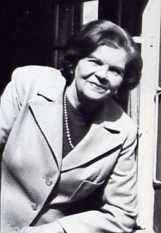
(Alice Henriette Alberta Herdan-Harris von Valbonne und Belmont, divorced Frank, married Zuckmayer)
born on April 4, 1901 in Vienna, Austria-Hungary
died on March 11, 1991 in Valais, Switzerland
Austrian writer; wife of Carl Zuckmayer
125th birthday on April 4, 2026
Biography
“Mrs. Zuckmayer is studying medicine so that her husband won't notice that she can't cook!” Emil Jannings sneered. Alice laughed about it. The former actress had caught up on her high school diploma and had then begun to study medicine. Fleeing from the Nazis put an end to her academic plans after seven semesters.
She had met Carl Zuckmayer at a party in Berlin in the 1920s. Alice walked among the “topless” women in a high-necked dress. When they married, both were penniless. Alice brought a huge lampshade into the marriage—and her two-year-old daughter Michaela.
A year later – Der fröhliche Weinberg (The Merry Vineyard) had brought Zuckmayer fame and fortune – they owned a house, an apartment… and they had a second daughter in the cradle, named Winnetou. National Socialism ended this happy time.
After a few quiet years in their house in Henndorf, Austria, the family was again forced to flee. They fled first to Switzerland, where they later returned after the war, before emigrating to the United States in 1939.
Alice Herdan-Zuckmayer vividly recounted her difficult survival as a farmer in Vermont in her best-known book, Die Farm in den grünen Bergen (The Farm in the Green Mountains). She had long since learned not only how to cook, but also how to cope with seemingly insurmountable problems, whether it was a years-long rat infestation or the arduous journey to the library in winter. “Those were our happiest years…”
Alice Herdan-Zuckmayer wrote several books, all of which were autobiographical: Das Kästchen (The Box) atmospherically describes her childhood in Vienna during the Austro-Hungarian monarchy. Das Scheusal (The Monster) focuses on an ancient dog, and Genies sind im Lehrplan nicht vorgesehen (Geniuses Are Not Provided for in the Curriculum) pays tribute to the educator Dr. Eugenie Schwarzwald. Her books read like a supplement to the autobiography (Als wär's ein Stück von mir, A Part of Myself) of her “Zuck”.
Incidentally, Alice played a part in the success of Der fröhliche Weinberg. Zuck read the manuscript to her: “I laughed and laughed throughout the first three acts… I almost fell out of my chair. But during the fourth and fifth acts, I felt my laughter becoming increasingly sparse…” Zuck shortened the play by two acts. “The reading of the new version took two and a half hours. This time I laughed and laughed with a light heart.”
The long-awaited stage success came this time: Zuckmayer received the Kleist Prize.
(Text from 2000, translated with DeepL.com; edited by Ramona Fararo, 2026.
Please consult the German version for additional information, pictures, sources, videos, and bibliography.)
Quotes
Alice Zuckmayer became a writer on the farm – interestingly, by describing the very circumstances that were so difficult for him as a poet. In fact, some of her stories and letters were already literary works. But she was not aware of this; it was only on the farm that she discovered her talent. (Piltti Heiskanen in Die Sterne sind geblieben [The Stars Have Remained], p. 9)
If you hold the rights to one or more of the images on this page and object to its/their appearance here, please contact Fembio.