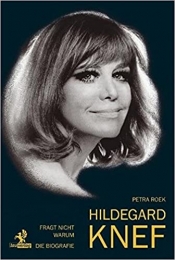
born on December 28, 1925, in Ulm, Germany
died on February 1, 2002, in Berlin, Germany
German actress, chanson singer, and author
100th birthday on December 28, 2025
Biography
The length of her career was as unrivalled as it was astonishing: for over 50 years Hildegard Knef enthralled audiences across the world. Alongside Marlene Dietrich and Romy Schneider, she was the only German film star of international stature. The German actress and singer, one of the most popular representatives of German cinema in the 1950s and 1960s, was an international sensation whose films, books, and songs won numerous awards.
Hildegard Knef was born on December 28, 1925, in Ulm, the daughter of a merchant family. Her father died in 1926, and her mother moved with her to Berlin where Hilde received her first acting lessons at the age of 15. After completing her professional training as an animator, she started attending the film school in Babelsberg in 1942. After the war, she initially performed on stages in Berlin.
She played her first leading role in 1946 in Wolfgang Staudte's Die Mörder sind unter uns (Murderers Among Us). The film, set amid the cratered landscape of Berlin, made her famous overnight. It tells the story of surgeon Hans Mertens, who returns to a destroyed Berlin disillusioned and without hope after the difficult war years. There he learns that his former company commander, who had ordered the shooting of innocent hostages in Poland, is now enjoying a comfortable life in Berlin as an up-and-coming businessman. Hildegard Knef, in the role of a former concentration camp inmate, ultimately prevents her friend Mertens from executing the undiscovered Nazi henchman. The film was a first attempt to come to terms with Germany’s Nazi past.
In 1948, Hildegard Knef was awarded Best Actress at the Locarno Film Festival for her role in Film ohne Titel (Film Without a Title). After a brief interlude in the United States, the 24-year-old returned to Germany where she took on the leading role in Willi Forst's film Die Sünderin (The Sinner) in 1950. Depicting the fate of a young woman who becomes a prostitute as a result of the war and post-war events, it includes a brief nude scene that made the film a major scandal in post-war German cinema. There were demonstrations and boycotts even before the movie premiered; church representatives in particular stirred up outrage, and clergy threw stink bombs when it ran in cinemas. However, the uproar only increased her popularity.
In the same year, she starred in the film Decision Before Dawn, which was also a box office success in the United States. This helped her land roles in several Hollywood productions, such as in the Hemingway adaptation of The Snows of Kilimanjaro (1952) alongside Gregory Peck. Hildegard Knef’s decisive international breakthrough came when she appeared in Cole Porter's musical Silk Stockings, giving 675 Broadway performances as Ninotchka between 1954 and 1956. Despite this triumph she was not very interested in show business and she therefore returned to Germany where leading roles in Die Dreigroschenoper (Threepenny Opera) and Wartezimmer zum Jenseits (Waiting Room to the Beyond) awaited her. She quickly became Ufa's number one star.
In 1963, she launched her second highly successful career as a chanson singer. She began writing her own lyrics, incorporating elements of jazz and swing. Her smoky voice became her trademark. Countless songs she wrote became hits, making her the most successful German chanson performer between 1963 and 1975. Ella Fitzgerald, the American jazz singer, once remarked that “she is the greatest singer without a voice.”
In 1970, Hildegard Knef then debuted as an author with her autobiography Der geschenkte Gaul (The Gift Horse). In it, she told the story of her life with refreshing honesty, recounting her experiences during the war, her major failures, and her successes. The book became a literary sensation and sold over three million copies worldwide. Her popularity knew no bounds: Germans fondly called her “unser Hildchen” (our little Hildie) or, more respectfully, “die Knef.”
Her third book, Das Urteil (The Verdict, 1975), also caused a sensation: she shared her experience with breast cancer in detail and with great openness. Despite further operations and drug addiction, she continued to appear in films over the following years, e.g., in the Fallada film adaptation Jeder stirbt für sich allein (Everyone Dies Alone). In the 1980s and 1990s, she appeared increasingly in TV productions. She made her last public appearance at the Berlinale in 2001. On February 1, 2002, Hildegard Knef died in Berlin at the age of 76.
Hildegard Knef was revered and reviled, loved and hated. But what remains is that she was a world-class character actress and chanson singer. As the New York Times once wrote: “Knef is one of the best things to have ever come out of Germany.”
(Text from 2020; translated with DeepL.com; edited by Ramona Fararo, 2025. Please consult the German version for additional information, pictures, sources, videos, and bibliography.)
Quotes
Visiting Billy Wilder
Oscar-winning Billy Wilder lived far removed from humility, melancholy, and memories. He was established and owed his early successes to Hollywood. He had become what I considered desirable at the time: victorious in America. When we stood in front of his house for the first time, I was nervous, as if I had to pass a test, a test of courage. Invited for drinks and dinner, I had spent the whole day fussing over what to wear and styling my hair, unsure of myself. The doorbell rang out with a delicate tinkling that seemed incongruent with the nervous energy of the house’s hyperactive owner. He opened the door. His round head with closely cropped hair, his taut, shiny face with eyes that missed nothing and judged everything, his cynical, mocking mouth, his sharp, nasal voice and rapid-fire monologue – they all added up to the image of a sovereign who never rests, a victor who distrusts the conquered. He paralyzed me and spurred me on, made me feel insecure and self-assured at the same time. (from: Der geschenkte Gaul)
If you hold the rights to one or more of the images on this page and object to its/their appearance here, please contact Fembio.