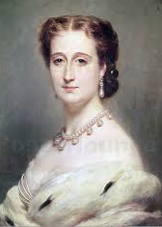
(née Eugenia Maria de Montijo de Guzman)
born on May 5, 1826, in Granada
died on July 11, 1920, in Madrid
Empress of France
200th birthday on May 5, 2026
Biography
Eugenia Maria de Montijo de Guzman, a Spanish noblewoman who lived in Paris with her mother and had access to the highest circles of society, married Napoleon III in 1853. He was a nephew of Napoleon I, the grandson of his wife Joséphine, and the son of her daughter Hortense. Louis Napoléon, 18 years older than Eugenia, had become Emperor Napoleon III in a referendum held the previous year and had been searching for a suitable wife for some time. He fell deeply in love with the beautiful Eugenia, who was as witty and spirited as she was virtuous, and who met all his expectations. She even gave birth to the long-awaited heir to the throne, albeit only after endless suffering and several miscarriages. In view of her weakened health, her doctors advised her to abstain from intimate relations. Her insatiable husband then soon resumed his premarital habits with a constantly changing string of mistresses. He had already cheated on her just six months after the wedding.
The Second Empire, which was extremely glamorous not least thanks to Empress Eugénie’s charisma, lasted only 17 years. As a temporary regent during Napoleon’s war-related absences and as an advisor whom he gladly consulted, Eugénie wielded considerable influence. Bismarck, who served as an envoy at her court in the early 1860s, even remarked that Eugénie was the only man in the French government. Unfortunately, she did not always have the best political ideas: she vigorously pursued Emperor Maximilian’s ill-fated Mexican adventure and also advocated for the war against Prussia, while Napoleon had tried with all his might to prevent this catastrophe.
When Napoleon III was dethroned in September 1870 following the lost Battle of Sedan, Eugénie had to immediately flee to England. They initially resided at Camden Place in Chislehurst, before settling at Farnborough Hill in Hampshire, where Eugénie had a massive memorial church and a mausoleum built for her husband, who died in 1873 following bladder surgery, and for her son, who was killed in action in South Africa in 1879.
She herself had another 50 years to live after the end of the Second Empire. Unlike the eternally mourning widow Queen Victoria, with whom she was good friends, Eugénie did not grieve too deeply for her husband, although she mourned the loss of her only son. She spent the second half of her life as a rather merry widow who enjoyed socializing with nearly all the royals of her time.
(Text from 2000; translated with DeepL.com; edited by Ramona Fararo, 2026.
Please consult the German version for additional information, pictures, sources, videos, and bibliography.)
Quotes
QUOTES
“The great event of the day is the incredible marriage of Emperor Nap… The future bride is beautiful, clever, very coquettish, passionate, and wild.” (Queen Victoria of England)
” So I did my utmost to learn to understand the great matters that occupied the Emperor. I had him explain them to me. I took notes; I read everything that could instruct me, that could enlighten me. Diplomacy interested me to the highest degree; I knew of no greater passion than to speak about it with… foreign statesmen who came to the Tuileries…” (Empress Eugénie)
“In every article of this peace treaty I see a small egg, a seed of further wars… The Allies are imposing impossible conditions. Not content with that, they are setting out to destroy German shipping, trade, everything. How can Germany ever raise the money to pay its just debts? Lunacy! Madness!” (Eugénie on the Treaty of Versailles)
“The Emperor (Wilhelm II) will surely abdicate; the other crowned heads will also go—in time, they will all go. King George will be the only one who remains…” (Empress Eugénie, 1918)
If you hold the rights to one or more of the images on this page and object to its/their appearance here, please contact Fembio.