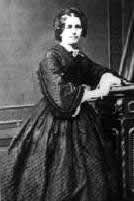
born on June 12, 1827, in Hirzel, Canton of Zurich
died on July 7, 1901, in Zurich
Swiss writer
125th anniversary of her death on July 7, 2026
Biography
Across the world, Johanna Spyri is by far the best-known Swiss personality—a fact that stands in marked contrast to her introverted and aloof nature. She wrote the story that was to become a global bestseller in just a few weeks in the fall of 1879, at the age of 52. The introduction to Heidi, the classic Heidi’s Years of Learning and Wandering, was published in 1880; the second volume, Heidi Can Use What She Has Learned, followed a year later.
The story of Heidi, the orphan girl who grows up with her gruff grandfather in the Swiss Alps and later restores the will to live in the paralyzed daughter of a wealthy Frankfurt merchant family, has been translated into over 50 languages and adapted for film many times. Johanna Spyri’s humor, her deep piety, and above all her quite unusual understanding of the inner world of children’s thoughts and feelings render the story of Heidi irresistible.
Johanna Spyri grew up as the daughter of the physician Johann Jacob Heusser and the Pietist poet Meta Heusser–Schweizer in the small rural community of Hirzel above Lake Zurich. At sixteen, she left home to attend a boarding school in Yverdon. She returned at the age of 18, spending the following seven years tutoring her younger siblings and helping her mother with the housework—as well as reading whenever she could. In 1852, she married the lawyer and editor Bernhard Spyri, who became the Stadtschreiber (a high-ranking city official) of Zurich in 1868 (from then on until her death, Johanna Spyri was addressed as Frau Stadtschreiber). The couple had one son, Bernhard. He died of tuberculosis in 1884, at the age of 28; his father died that same year.
It was not a very happy marriage. Bernhard Spyri was a workaholic and Wagner fan who showed little interest in his young wife: “We don’t eat anything at all in our house anymore; at lunch today, my husband was reading his newspaper so intently that he completely forgot about the food, and I’d had no appetite right from the start.” Johanna Spyri did not enjoy housework, and during her pregnancy she fell into a deep depression that lasted for years. A source of comfort during these difficult early years of marriage was her friendship with Betsy Meyer, the sister of Conrad Ferdinand Meyer. This relationship seems to have been the most intimate of her life—Johanna wrote Betsy loving, longing, even passionate letters: “Dear Betsy, will you find time to write me a few words? I long for them; don’t leave me alone without you for too long—you know the void you leave in my life” (1858). But Betsy Meyer withdrew.
A pastor who was a friend of her mother’s encouraged Johanna Spyri to write; in 1871, her first story, “A Leaf on Vroni’s Grave,” was published and became a great success. By today’s standards, it is a quite unsettling story about a woman abused by her alcoholic husband who in the end submits to her fate in prayer following the advice of a pastor.
Further publications followed—and then: Heidi! The lovable, cheerful child of nature assured her creator a very comfortable retirement.
During her final years, the widow Johanna Spyri continued to write stories for children. She travelled extensively and remained in regular, cordial contact with Conrad Ferdinand Meyer.
Emilie Kempin–Spyri, the first woman lawyer in Switzerland, was her husband’s niece. Johanna herself did not think much of women’s education. Yet when she fell ill with cancer in 1901, it was Marie Heim–Vögtlin, Switzerland’s first woman doctor, who treated her.
(Text from 2000; translated with DeepL.com; edited by Ramona Fararo, 2026. Please consult the German version for additional information, pictures, sources, videos, and bibliography.)
Quotes
Johanna Spyri sought to share her own experiences with her readers; she wanted to show them what is needed in this world. Through her writing, she sought to educate, and through her writing, she ultimately succeeded in overcoming her own hardships and thus truly coming to terms with the real world into which she had been placed. (Jürg Winkler)
[In Zurich, at Zeltweg No. 11] Johanna’s estate is preserved: papers, books, files. Inanimate objects belonging to the elusive woman about whom we know so much, yet who remains painfully unfamiliar to us, while the child Heidi lives on, casting off her clothes, following the goats up the mountain, toward the sky. (Regine Schindler)
If you hold the rights to one or more of the images on this page and object to its/their appearance here, please contact Fembio.