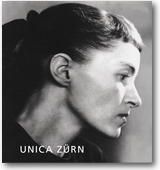
((Nora Berta Unica Ruth Zürn [full name]))
born on July 6, 1916, in Berlin-Grunewald
died on October 19, 1970, in Paris
German writer and graphic artist
110th birthday on July 6, 2026
Biography
Even her name has a magical ring to it; she actually was christened Unica. After finishing school, she worked first in the editing department, later in advertising film dramaturgy at the German film agency UFA.
In 1949, after separating from her husband and leaving her two children behind, she began writing short stories and fairy tales for Berlin newspapers as well as plays for radio. In 1953, she met Hans Bellmer and followed him to Paris, where she lived with him for 17 years in a sort of love-hate relationship.
The influence of the last Surrealists shaped her work: Through Henri Michaux, she discovered the method of automatic writing and drawing for herself. Her first exhibition at the Paris gallery Le Soleil dans la Tête was followed by others; in 1954, her first anagram poems, Hexentexte (The Witches’ Texts), were published.
Anagrams, drawings, and prose are three aspects of a body of work full of otherworldly, chimerical figures and horrific visions. Countless eyes gaze out from the fluid figurations and meticulous ornamentation—unmistakably the eyes of Unica Zürn. Her prose—The Man in the Jasmine—Impressions from a Mental Illness, Notes of an Anemic Woman, Imaginary Letters—has an autobiographical tone.
What writing and image have in common is the revelation of the workings of the unconscious, whether as the constructive principle of a creative automatism or as the multilayered meanings within a given text. She used quotations, lines of poetry, or idioms as a starting point for the search for the solution to self-posed riddles. Language became for her the place where deep secrets were hiding, an oracle.
This juggling with semiotic coincidences became Unica Zürn’s favorite pastime, and later a mania—analogous to Hans Bellmer’s dissection and reassembly of dolls.
In her writing, she often anticipated death, including her own suicide in the early story Dark Spring: “It’s over,” she says softly, before stepping off the windowsill. She falls on her head and breaks her neck. Her small body lies strangely contorted in the grass.”
(Text from 1990; translated with DeepL.com; edited by Ramona Fararo, 2026.
Please consult the German version for additional information, pictures, sources, videos, and bibliography.)
Quotes
Without yet having lived, I will die
without heirs, lying in my soft bed, my neck broken
after ten yellow autumn weeks—oh, the bleakness…(Paris 1959)
If you hold the rights to one or more of the images on this page and object to its/their appearance here, please contact Fembio.