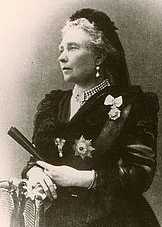
born on November 21, 1840, in London
died on August 5, 1901, at Friedrichshof Castle near Kronberg in the Taunus mountains
German Empress
125th anniversary of her death on August 5, 2026
Biography
Victoria, the first child of Queen Victoria and her consort Prince Albert, grew up loved and cherished. She was highly gifted and eager to learn. At age 17, she married the dashing Prussian Crown Prince Friedrich, who was nine years her senior and who shared Vicky’s liberal and idealistic political views. The two enjoyed a happy marriage. Between 1858 and 1872, Vicky gave birth to a child every two years with remarkable regularity.
Vicky had a very close relationship with her mother, documented in thousands of letters. I am not aware of a more extensive correspondence between two women.
However, that is the extent of the happiness Vicky experienced. She otherwise had to endure an inordinate amount of physical and psychological pain, giving birth to her first son, the future Emperor Wilhelm II, after hours of excruciating agony. The heir to the throne suffered birth injuries that had far-reaching consequences for German history. His left arm was paralyzed, and he also suffered brain damage due to a lack of oxygen.
Vicky and Crown Prince Friedrich were brilliantly prepared for their royal duties—for 30 years they had waited impatiently to introduce liberal, progressive policies in Prussia and (from 1871 onward) in the saber-rattling, chauvinistic German Empire. When Emperor Wilhelm I (finally) died in 1888 at the age of 91, Friedrich was already terminally ill —he reigned for only 99 days during this “Year of the Three Emperors,” after which he was succeeded by his (probably manic-depressive), politically inept, ultra-conservative, and militaristic son, Wilhelm II, who reigned for 30 years and unleashed World War I in 1914, claiming 10 million lives. The thought that Wilhelm II created a climate and brought about a situation in which Hitler was ultimately able to rise to power—and that it was merely a terrible coincidence that the enlightened and peace-loving couple Friedrich and Victoria were not able to shape those 30 years in his place—is hard to bear.
Throughout his life, Bismarck polemicized and schemed with relish against the crown prince and princess, and after Friedrich had died in terrible agony, Vicky’s son Wilhelm systematically continued the humiliations.
Vicky built her retirement home, “Friedrichshof,” in Kronberg in the Taunus mountains. It was so centrally located that the royal highnesses of Europe passing through—almost all of whom were related to her in some way—gladly and frequently stopped to stay with her. Vicky read, studied, painted, and was active in charity work—she was deeply interested in everything, in stark contrast to her eldest son, who could not concentrate on anything for long and compulsively engaged in empty busyness with military pomp.
Gradually, however, a more peaceful relationship developed between mother and son; Vicky was granted a few more happy years before she was diagnosed with breast cancer in 1899. Like her husband’s, the illness proved to be extraordinarily agonizing—Queen Victoria sent a doctor with ample morphine, but Wilhelm decided that an English doctor was incompatible with the honor of German medicine. As the German doctors administered morphine only in tiny doses, Victoria suffered unbearable pain for months, often screaming for hours on end. In early 1901, Queen Victoria—her only source of support besides Vicky’s three youngest daughters—died a quick and peaceful death. Her eldest daughter followed her a few months later, in August 1901.
(Text from 2000; translated with DeepL.com; edited by Ramona Fararo, 2026.
Please consult the German version for additional information, pictures, sources, videos, and bibliography.)
Quotes
She will mean nothing to world history, which consists of galleries of princes with battle scenes in the background. But she will go down in cultural history ... as the first princess to use her full influence for the women’s movement at a time when the yoke of convention still weighed heavily upon her. (Helene Lange)
If you hold the rights to one or more of the images on this page and object to its/their appearance here, please contact Fembio.