

Fembio Special: Bauhaus women
Maria Marc
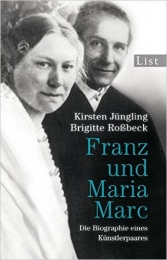
(Bertha Pauline Marie (Maria) Marc, née Frank)
born on June 12, 1876, in Berlin
died on January 25, 1955, in Ried near Kochel, Upper Bavaria
German painter and weaver; wife of Franz Marc
150th birthday on June 12, 2026
Biography
Maria Marc, the daughter of a bank director, began her training as an “academic” painter at an early age. As a woman she was not allowed to study at a state art academy, so she attended the Damenakademie (Ladies Academy of the Artists' Association) in Munich. In the summer she travelled to Worpswede (where she was taught by Otto Modersohn) and to Dachau Moos. In 1905, she crossed paths with Franz Marc in Schwabing. In those early days, however, the painter’s other lovers—he managed to maintain a four-way relationship, pushing both his and her limits to the extreme—made her life and love quite difficult. He also made her work difficult; he intervened with corrections more and more ruthlessly. Her oeuvre is nonetheless impressive, today more than ever: in 1995 and 2004, it was presented to the public at the Lenbachhaus in Munich and the Schlossmuseum Murnau. However, there was one area—music—where she was superior to Franz Marc: she was an accomplished pianist.
Although Maria Marc contributed some of her own works to the first Blauer Reiter exhibition in 1910, she chose not to participate further. Her friend August Macke had also advised her to refrain from exhibiting. As a reward, unlike the “stubborn” Münter, she was wedded. For Franz Marc, it was his second marriage. It ultimately lasted, despite fierce disagreements during World War I. She was a pacifist, he (initially) a jingoist—who knows where that would have led if his death in battle hadn’t made her a widow so early.
After 1916, Maria Marc took a new artistic direction: she studied at the Bauhaus, learned weaving and wool dyeing, and began to create artistic tapestries (which were also later worthy of exhibition). Like other members of the Munich bohemian scene, she then settled at Monte Verità near Ascona, where she rekindled her old friendship with Marianne von Werefkin.
Maria Marc had suffered from rheumatic pain since her youth; months-long stays in the south provided relief. They also did her soul good and gave her distance from the Nazi Germany she despised. She never regained her great joy in life after Franz Marc’s death. Maria Marc did not return permanently to her home in the Upper Bavarian Ried near Kochel until after World War II. She spent the final years of her life there. Any time she could spare after weaving was devoted to promoting the work of her husband—who had only recently become famous.
(Text from 2004; translated with DeepL.com; edited by Ramona Fararo, 2026.
Please consult the German version for additional information, pictures, sources, videos, and bibliography.)
If you hold the rights to one or more of the images on this page and object to its/their appearance here, please contact Fembio.
