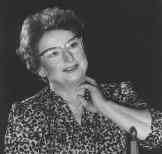
born on August 10, 1926, in Saint-Germain-en-Laye
died on February 26, 2013, in Le Pecq, near Paris
French organist and musicologist
100th birthday on August 10, 2026
Biography
I come from a musical family; we played Bach practically every evening, on the organ, and sang cantatas—Bach was almost a family obsession for us.
Marie-Claire Alain, often called the “Queen of the Organ” and the recipient of countless honors and awards, was born in 1926 in St.-Germain-en-Laye, a suburb west of Paris where she continued to serve as organist every Sunday at the two Masses well into old age—even though she had other tasks and would have preferred to “make breakfast and take care of her grandchildren on Sundays.”
She came from a dynasty of musicians. Marie-Claire’s grandmother was a well-known pianist. Her father, Albert Alain, served as organist at the church in Saint-Germain-en-Laye for over 60 years. Her two brothers, Jehan and Olivier, became organists and composers like their father. Jehan (1911–1940)—arguably the most gifted composer of the three men—died during World War II at the age of 29. His younger sister Marie-Claire, whom he had taught so much on the family’s organ—built by their father—was just 13 years old at the time of his death and would go on to champion his work through concert performances around the world, much as Clara Schumann did for Robert.
Marie-Claire Alain recorded over 260 records and CDs, including the famous complete recordings of the organ works of Bach, Buxtehude, Bruhns, Böhm, Couperin, Grigny, Daquin, Pachelbel, Mendelssohn, César Franck, and Jehan Alain.
She gave over 2,500 concerts across the world; in the summer of 2005, at the age of nearly 79, she gave a concert at Sanssouci to mark the 300th anniversary of the death of Queen Sophie Charlotte of Prussia. Critics unanimously praised the transparency and “clarté” of her playing, her fabulous art of registration, her musicality, and her passionate intensity. “Old” music came alive under her hands, and new music—such as the Litanies or Deuils by her brother Jehan—she made cry out to the very limits of pain. These were the dirges for her sister Odile, who died in the mountains in 1937 at the age of 23 while trying to save their little brother Olivier. Marie-Claire was only eleven at the time, and three years later she was to lose Jehan as well.
Marie-Claire Alain recorded Bach’s organ works three times: once in the 1960s, then again in the 1970s. Her last recordings were made in 2002-2003 when she commented on the first two cycles:
I never listen to them! Only when I have to—I don’t hate them, but there’s a lot I wouldn’t do that way anymore. My first complete recording was more instinctive, the second was already much more deliberate, and the last one benefits from a long life of musical work and research.
Marie-Claire Alain died at the age of 86 on February 26, 2013, in Le Pecq near Paris.
(Text from 2005; updated 2013; translated with DeepL.com; edited by Ramona Fararo, 2026.
Please consult the German version for additional information, pictures, sources, videos, and bibliography.)
Quotes
You have to know the whole of Bach; then you’ll find consistent modes of expression in his work. Suffering, for example, he expresses through chromaticism or note repetitions; joy through trills. Christmas with a descending line—Christ’s descent to earth. The Passion with musical figures in the shape of a cross. There is a whole system of religious numerical symbolism here. Numerical symbolism was widespread in Bach’s time; one finds it in Schütz and Scheidt, but in Bach’s work it is much more pronounced than in that of his contemporaries. (Marie-Claire Alain)
If you hold the rights to one or more of the images on this page and object to its/their appearance here, please contact Fembio.