
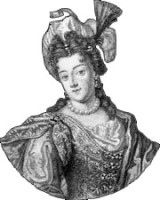
(Mlle de Scudéry; Scudéri, Madeleine de; Villeneuve, ... de [pseud.]; Scudery, Madelaine de)
born on October 15, 1607, in Le Havre
died on June 2, 1701, in Paris
French writer and salonière
325th anniversary of her death on June 2, 2026
Biography
Among the famous literary salons founded by women in 17th-century Paris, it is Mlle de Scudéry’s that deserves special attention. Until then, these gatherings—where women enjoyed a certain degree of autonomy—had been reserved exclusively for the nobility and a small number of writers. Scudéry, however, chose to include in her circle predominantly bourgeois women and men who were committed to refining language and manners and to cultivating all virtues, especially friendship.
A new variation of erotic relationships, focused solely on the exchange of tender poems, letters, and conversations, was her invention. She ensured that boundaries were respected. “Tendresse” (tenderness, sensitivity) rather than passion was the ideal to which she remained devoted throughout her life; it was an ideal she strove for even during her long friendship with Paul Pellisson, the love of her life.
Scudéry was unlike other salonières in an additional respect: whereas they had the time and money to indulge in frivolous pastimes and the study of literature, she had to earn her living through writing. She and her older brother Georges were orphaned at an early age and then taken in by an uncle who ensured they both received a good education. From 1630 onward, the siblings lived in Paris; she managed the household and was exploited by her tyrannical brother. After a brief military training, Georges devoted himself primarily to writing and became a successful playwright.
From 1649 to 1653, the ten-volume heroic adventure novel Le grand Cyrus (The Great Cyrus) was published, followed by the equally extensive La Clélie, both under his name, although it was common knowledge that his sister was the author. These rambling novels, which are barely readable today, enjoyed immense success and literary influence in France and, through translation, in other countries as well. In Paris, they aroused particular interest because of the coded portraits of contemporaries, who were eager to discover themselves in ancient guise and who then adopted the Greek or Roman names they were given in the novels. This became a sort of parlor game, not only at Madeleine’s “Samedis” in her salon, which she had held in the Marais district of Paris since 1652. She herself was Sappho, through whom she expressed her own, very modern views: “Sappho” advocated for better education and training for women and the rejection of seduction through beauty and of marriage as a woman’s life goal. Famous literary giants such as Boileau and Molière (Les Précieuses Ridicules) attacked Scudéry with malicious satires, yet they were unable to diminish her triumph.
It was not until Georges left Paris in 1654 that Madeleine became truly free and independent; she was then also free of his tormenting jealousy of her friend Pellisson. Pellisson was 16 years her junior, a lawyer by profession, and later the king’s secretary. He came from a Huguenot family in southern France; his ugly face was disfigured by smallpox scars. Madeleine, whose own appearance was also unattractive, valued his honest character and intelligence and remained unwaveringly loyal and devoted to him. When he fell out of favor with the king and was sentenced to prison in 1661, she did everything she could to ease his imprisonment and she secured his release after four years.
After her major novels, she continued to write tirelessly. Among other works, she published novellas and a chronicle of the salon. Despite painful rheumatism and eventually complete deafness, she maintained contact with friends through extensive correspondence well into old age. She remained mentally alert and interested and outlived almost everyone, including, to her great sorrow, her friend Pellisson. She died at the age of 94.
(Text from 2000; translated with DeepL.com; edited by Ramona Fararo, 2026.
Please consult the German version for additional information, pictures, sources, videos, and bibliography.)
Quotes
QUOTES
L'amour peut aller au–delà du tombeau, mais elle ne va guère au-delà du mariage. (Love may outlive death, but rarely marriage.) (Scudéry, “Le Grand Cyrus”)
I know of nothing that brings more shame upon our sex than the fact that a woman is not obliged to learn anything. For this reason, I wish that they were also forbidden to speak, and that they were not taught to write; for if they are to do both, then everything that enlightens the mind, forms judgment, and teaches them to speak and write well must also be made accessible to them. Is there anything stranger than the education of women? They are not to be coquettes, yet they are permitted to study everything pertaining to coquetry, while being forbidden the knowledge that strengthens virtue and engages the mind. (Madeleine de Scudéry, quoted in: Büchner, Luise: Women and Their Vocation. Frankfurt am Main (Valentin Meidinger) 1855, pp. 51–52)
Scudéry, Magdalene von, born in 1607 in Le Havre, where her father served in the royal court, was the sister of Georg von Scudéry, who was also known as a writer, and, as soon as her education was complete, went to Paris, where her witty conversation and extensive knowledge soon gathered the most distinguished men and women around her. At that time, the endless novels of Calprenède and Homberville were particularly popular with the public. Mademoiselle de S. sought to compensate for her lack of material wealth by devoting herself to literary works, in which she appears to have taken those novels as her model. She possessed the peculiar habit of endowing her heroes—mostly chosen from antiquity—with a sweet, amorous nature. This is evident, among other works, in the novel *Clélie*, in which she portrays the greatest men of the Roman Republic—Horatius Cocles, Mucius Scaevola, and others—as devoted solely to the service of love and women. The great acclaim that the works of Miss de S. received, even though they too suffered from the shortcomings of the time, must be attributed largely to the fact that she mostly depicted court intrigues and wove portraits of well-known persons under borrowed names into her novels.
Her works also lacked naturalism, a deficiency which, incidentally, was regarded at the time as a virtue rather than a flaw; one cannot deny her a lively, fertile imagination, any more than one can deny her a pure, flowing style of writing. The reputation of this writer’s talents soon spread to foreign lands as well. Queen Christina of Sweden honored her with her friendship and maintained a close correspondence with her. The Accademia dei Rizzorali in Padua admitted her as a member. When the Academy of Paris announced the first competition for the prize for French eloquence, endowed by Balzac, in 1671, Miss de S. won with her “Discours de la gloire.” She was exceptionally ugly, and her lifeless, strong features revealed only faintly the superiority of her mind and the depth of her inner world; yet in close company, her richly gifted intellect, the nobility of her soul, and her unassuming modesty made it easy to overlook her lack of outward beauty. Mademoiselle de S. lived into old age and enjoyed the rare good fortune of retaining mental faculties so fresh that she composed a poem about Louis XIV even at the age of 92. She died on June 2, 1701, at the age of 94. Her literary legacy consists of several novels, some of which run to eight to ten volumes, and of treatises on various subjects; the Entretiens de morale rank among the finest works to have flowed from her pen and will always provide good and useful reading. E. v. E. (Encyclopedia entry: Scudéry, Magdalene von. In: Damen Conversations Lexikon, Vol. 9, edited by Carl Herloßsohn, Leipzig 1834–1838, p. 187 ff.)
If you hold the rights to one or more of the images on this page and object to its/their appearance here, please contact Fembio.