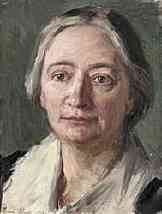
born on December 11, 1849 in Sundsholm, Sweden
died on April 25, 1926 in Vattersee, Sweden
Swedish educator and publicist
100th anniversary of her death on April 25, 2026
Biography
In 1895, Ellen Key gave a lecture on the controversial topic of “the misused power of women” at a women's conference in Copenhagen. Previously an unknown teacher and lecturer at the Workers' Institute in Stockholm, she subsequently became a focal point of the European women's movement and an influential publicist. According to Ellen Key, women are different from men and they should recognize this for their own good and for the good of human society. “Mannish women,” she asserted, only support dangerous, decadent tendencies in modern society; these women even act against their nature, since women can never achieve what men achieve in art, philosophy, and other fields. As mothers, however (also in a figurative sense), women could play a vital historical role in countering inhuman, individualistic tendencies.
Ellen Key grew up as the daughter of a wealthy and liberal family. She was educated athome and displayed an aversion to housework at a young age. Her mother supported her inher desire to develop her personality. The family ran into financial difficulties, and Ellen Key, who had not married, took up a teaching position at Anna Whitlock's girls' school in Stockholm in 1880. At the same time, she began lecturing at the local folk college. She was a very popular teacher and lecturer who also advocated various liberal ideals (freedom of speech, individualism), often for women, especially working women.
After her appearance in Copenhagen, her life changed dramatically; she became a publicist with a Europe-wide reputation.
Declared enemies of the women's movement quoted her approvingly, while women of the liberal wing of the movement (such as Hedwig Dohm) attacked her as an anti-feminist. Other women (Laura Marholm, Lou Andreas-Salomé), including members of the women'smovement (Helene Stöcker), welcomed her writings. Key understood the term ‘mother’ not only in the context of a biological family or in mere biological terms: women should also be ‘motherly’ as teachers and benefactors and commit themselves to peace. She had a great influence on the movement for maternity protection; as an educator, she advocated an anti-authoritarian, child-centered method of education. Among her many influential writings areLove and Ethics, On Love and Marriage, The Women's Movement, Rahel, and above all The Century of the Child (1900). Similar to the evolutionary monism that was widespread at the time, she understood women, the earth, and peace as a triangle. She wanted to contribute to a modern belief in life in all its immanence.
She admired Rilke for a time; his image of women also influenced her. Throughout Europe (and also in North America), she exerted a strong influence on the image of women—and of human beings in general. Ellen Key became increasingly popular and was able to give up her job as a teacher in 1899. In 1903, she held her last lecture at the folk college.
From then on, she traveled throughout Europe for years at a time and met many influential people. The Swedish government gave her a piece of land on Lake Vattersjön, and with the proceeds from her books, she built a house she named Strand there. After 1903, she never returned to Stockholm; she preferred the peace and quiet of the countryside. She worked on her writings in Strand until her death.
(Text from 1998; translated with DeepL.com; edited by Ramona Fararo, 2026. Please consult
the German version for additional information, pictures, sources, videos, and bibliography.)
Quotes
The first ‘women's movement’ was Eve's. It began at the moment when she stretched out her
hand toward the fruit of the tree of knowledge. (1909)
The woman who does not nourish the fruit of her mind just as she does the fruit of her body
with her own blood, who is not equally capable of self-denial, who does not become equally
ruthless in the face of danger when the life of her work is at stake as when the life of her child
is at stake, is not called to give birth in the spiritual domain. (1898)
Art, like science, has no place for a woman. (1898)
If you hold the rights to one or more of the images on this page and object to its/their appearance here, please contact Fembio.