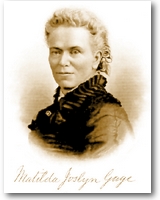
born on March 24, 1826, in Cicero, New York
died on March 18, 1898, in Chicago, Illinois
American women's rights activist, feminist historian, and theorist
200th birthday on March 24, 2026
Biography • Quotes • Weblinks • Literature & Sources
Biography
The American women's rights activist Matilda Joslyn Gage became widely known when a striking but until recently nameless phenomenon was named after her.
“The Matilda effect is a bias against acknowledging the achievements of women scientists and inventors, whose work is consequently attributed to their male colleagues. This phenomenon was first described by suffragist and abolitionist Matilda Joslyn Gage in her essay, “Woman as Inventor” (first published as a tract in 1870 and later published in the North American Review, retitled “Woman as an Inventor”, in 1883). The term Matilda effect was coined in 1993 by science historian Margaret W. Rossiter.” (Wikipedia)
Along with Elizabeth Cady Stanton and Susan B. Anthony, Matilda Joslyn Gage was one of the three most important campaigners for women's suffrage in the United States in the second half of the 19th century. She was both a leading theorist and activist, as well as co-author and co-editor of the first three volumes of the comprehensive History of Woman Suffrage (6 vols., 1881-86). Her astute and consistent, historically grounded analysis of the oppression of women still seems very radical and relevant today. For (as she had boldly claimed and compellingly argued) it was not women who needed to develop further in order to take their rightful place and contribute to culture, but the patriarchy (this indispensable neologism was coined by Gage!) that had claimed the great achievements of women in almost all fields for itself and thereby asserted its power. Displaying extensive historical knowledge, Gage revealed the contributions of important but forgotten women over the course of time, making the women visible after they had been erased by male historiography.
As the struggle for women's rights dragged on, Gage realized that suffrage alone would not be enough to free women. She believed that the deeper cause of inequality lay in the Christian church and its doctrine of female inferiority and sinfulness. She argued that this doctrine shaped the thinking of both women and men and also flowed into the ideology of the state. Like Elisabeth Cady Stanton, she pointed to a social order that was the complete opposite: the matriarchy of the Iroquois, who lived in her home state of New York, where women had always been in charge. After twenty years of research, she published Woman, Church and State: The Original Exposé of Male Collaboration Against the Female Sex (1893) which called on all women to fight against the harmful influence of religion. However, not only the conservatives among the women were put off by Gage’s attack on the church. Gage found herself marginalized, eventually even by her fellow activists Anthony and Stanton, and she was nearly eliminated from history. It is only thanks to Mary Daly (1978), Sally Roesch Wagner (1980), and Dale Spender (1982) that we can appreciate the significance of Gage’s ideas for today’s women’s movement.
Matilda Joslyn was the only child of Helen Leslie and physician Hezekiah Joslyn and enjoyed an unusually liberal upbringing for a girl. Her free-thinking father taught her Greek, mathematics, and physiology, and she also learned to think critically. Her parents were very hospitable, and enjoyed discussing women's rights, abolitionism, and other issues of the day with the progressive intellectuals who visited. The family home was likely also a station of the Underground Railway, providing slaves who had escaped a safe place to stay on their journey to Canada.
At eighteen, Matilda married haberdasher Henry Gage and became a housewife and then mother of five children. Her third child, a son, died after only four weeks, but the other four all lived well into their 80s, two even into their 90s. Maud (1861-1953), her youngest child, lived the longest. Maud’s husband, L. Frank Baum, wrote the best-selling children's book The Wonderful Wizard of Oz (1900), in which he incorporated ideas about witches, female power, and matriarchies that he owed to his mother-in-law Matilda Joslin Gage, especially her magnum opus Woman, Church and State.
Although in poor health—she had had a weak heart since her youth—Matilda soon became one of the most energetic and effective activists in the women's movement. “Had she been in full health, she would have done more for the emancipation of women than all of us put together. Despite her frail health, she worked wonders…” was the assessment of her famous comrade-in-arms, Susan B. Anthony.
In 1852, she appeared as the youngest speaker at the National Women's Rights Convention in Syracuse, New York, and wrote for the feminist newspaper The Revolution. As president of the National Woman Suffrage Association (NWSA) and the New York State Woman Suffrage Association, Gage spoke in favor of women's suffrage in hearings before the U.S. Senate and House of Representatives.
When she was unable to convince the women of the NWSA to take sides against the church, she founded a new organization in 1890, the Woman's National Liberal Union (WNLU). But there is almost nothing written about this organization in the history books. Like its founder, it was simply too radical.
(Text from 2025; translated with DeepL.com; edited by Ramona Fararo, 2026.
Please consult the German version for additional information, pictures, sources, videos, and bibliography.)
Quotes
There is a word sweeter than Mother, Home or Heaven – that word is Liberty.
Links
https://matildajoslyngage.org/home
Literature & Sources
Brammer, Leila R. 2000. Excluded from Suffrage History: Matilda Joslyn Gage, Nineteenth-Century American Feminist. Contributions to Women's Studies, Number 182. Westport CN. Greenwood.
Daly, Mary. 1978. Gyn/ecology: The Meta-Ethics of Radical Feminism. Boston. Beacon.
Gage, Matilda Joslyn. 1870. Woman as Inventor. Woman Suffrage Tracts No. 1. https://iiif.lib.harvard.edu/manifests/view/drs:2575141$2i
Gage, Matilda Joslyn. 1980 [1893]. Woman, Church and State: The Original Exposé of Male Collaboration Against the Female Sex. Watertown, MA. Persephone. (online: http://www.gutenberg.org/files/45580/45580-h/45580-h.htm)
Margaret W. Rossiter1993. “The Matthew Matilda Effect in Science”, Social Studies of Science. 23 (2). London, UK: 325–341. https://doi.org/10.1177/030631293023002004
Notable American Women: A Biographical Dictionary. 1971. Hg. Edward T. James, Janet Wilson James & Paul S. Boyer. 3 Bde. Cambridge, MA. The Belknap Press of Harvard UP.
Spender, Dale. 1982. Women of Ideas (and What Men Have Done to Them): From Aphra Behn to Adrienne Rich. London; Boston; Melbourne. Ark PB.
Wagner, Sally Roesch. 1980. “Introduction” to Matilda Joslyn Gage (1893): Woman, Church and State. Watertown, MA. Persephone. S. xv-xxxix.
Wagner, Sally Roesch. 2011. “How Native American Women Inspired the Women’s Rights Movement”, https://www.nps.gov/articles/000/how-native-american-women-inspired-the-women-s-rights-movement.htm
If you hold the rights to one or more of the images on this page and object to its/their appearance here, please contact Fembio.