
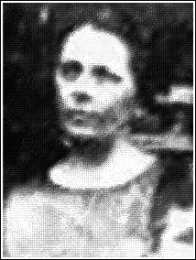
born on September 30, 1884, in Heidelberg, the German Empire
died on March 24, 1976, in Essen, West Germany
German gynecologist and obstetrician; pioneer of the women's movement
50th anniversary of her death on March 24, 2026
Biography • Quotes • Weblinks • Literature & Sources
Biography
It was the obligation that she felt to “not let things get lost that might be important to future generations” that motivated Toni von Langsdorff at the age of 91 to publish the story of her own education and training. The obstacles she faced in her pursuit of a career were the same as those encountered by practically all women of her generation; egregious misogyny and gross patriarchal arrogance were rampant.
During this dark period at the turn of the 19th to the 20th century (and further beyond) there were women who were inspired to resist. The rebellion of these defiant and extraordinary women against the patriarchal norms is evidence of their indestructible will as well as their unshakeable self-confidence, but it also points to the passion with which they pursued their dreams.
It was Toni von Langsdorff's dream to become a doctor, and she was one of the first women in Germany to achieve this. It took incredible courage to rebel against misogynistic laws that gave men a free hand. Women were willing to take to the streets, to go to prison – and, in extreme cases, to risk their lives – for Toni von Langsdorff and her peers. One need only recall the suffragist Emily Davison (1872–1913): in an act of desperation, she ran onto the Epsom Derby racecourse in 1913 to draw attention to the injustice. Crushed by the king's horse, she died of her injuries four days later. Toni von Langsdorff did more than survive her own fight for the right to pursue a career: she became a successful, highly respected gynecologist who advocated for the rights of all women to an education and a profession.
Toni von Langsdorff knew early on that “despite all conventions, I had to pursue a career that would make me independent.” She was fortunate to have the support of her parents, especially her mother, who was her role model during childhood and adolescence. Toni was the eldest of four daughters. Her father was a lieutenant colonel who was often transferred, requiring the family to move many times. For the girls, this meant frequent changes of school and few opportunities to build a stable circle of friends. Toni von Langsdorff attributed her courageous decision to study, and medicine at that, to her ancestors. Among these were scientists, theologians, and lawyers. One was a natural scientist who had taken part in major research expeditions – and her own life could actually also be viewed as a research expedition through the thicket of an arch-conservative social order.
Her mother had fallen ill following the birth of her third child. “But she was a woman of extraordinary willpower and self-discipline, who was very educated, had read a great deal while bedridden, and was very open to new ideas.” It was probably through her mother that Toni first learned of new educational possibilities for women, and of women who were even studying at universities. The freedom of thought of women's rights activists such as Helene Lange, Gertrud Bäumer, and Franziska Tiburtius, who campaigned for women's education, among other things, appealed to Toni’s “unbridled desire for independence.” “I found the thought of having to wait for a man or having to live my life as an ‘old maid’ without my own profession unbearable.”
Toni von Langsdorff's childhood and youth were overshadowed not only by her mother's chronic illness, but also by the serious illness of her younger sister Hertha (1891–1981). Hertha contracted tuberculosis at the age of six, was confined to bed for years, and had to undergo several operations. The tuberculosis healed, but she was left with severe disabilities. Hertha also became a doctor, practicing later as a pediatrician, and even sharing a practice with her older sister Toni from 1926 to 1937.
Toni attributed her desire to become a doctor to the constant presence of suffering and pain in her family, with the doctor always present to help and to heal, and thus becoming her role model.
However, there was one big BUT standing in the way of her dream: it was considered unsuitable for a woman to even study medicine, let alone to work as a doctor. Numerous reasons were given for this – first and foremost, the traditional division of roles between women and men. Even more important, however, were prejudices such as the supposed threat to the morality of female students posed by the “embarrassing” physicality of medicine in general. Yet the most compelling argument was the “scientific” argument of the “inferiority” of women believed to have been proven both anatomically and physiologically by Munich professor of anatomy and physiology Theodor von Bischoff (1807–1882). His research had revealed that women's brains weighed on average 134 g less than men's, which, for Bischoff, was clear proof of the inferior level of development in women. His conclusion that in all respects women were therefore closer to children than to men attracted a great deal of attention, not only among experts. That it is absurd and erroneous to draw conclusions about intellectual abilities based on the weight of a brain had long since been proven, not least thanks to Hedwig Dohm and her mocking reference to the enormous weight of an elephant's brain. However, it was not so much science as the fundamental social changes of the 20th century that paved the way for women's social and political emancipation – a process that is still far from successfully completed.
Toni von Langsdorff's decision to study medicine was strongly supported by her mother. The approval of her father meant almost more to her; she knew that in his military environment he was bound to encounter unsympathetic reactions and be ridiculed for his rebellious daughter.
For Toni von Langsdorff herself, high barriers arose long before she could even think about applying to university. She needed a high school diploma, but high schools did not accept girls. It was a lucky coincidence that a group of women had formed in Cologne, where the family was living at the time; the women had set themselves the goal of supporting girls who wanted to obtain their high school diploma with all the means at their disposal, including financial support. Toni von Langsdorff described the obstacles in her memoirs: “...it was a struggle to find high school teachers who would agree to teach us. Most teachers considered it beneath their dignity to teach girls ‘with their inferior intellect’ subjects such as Greek, Latin, and mathematics, as these were subjects reserved for the ‘superior male mind.’” The director of the Höhere Töchterschule (secondary school for girls) in Cologne, where Toni also attended courses as a guest student, was even more hostile. He considered her an “offensive revolutionary element” and, quoting from the Bible, told her mother, “if your eye offends you, pluck it out!”
At that time, girls had to take their high school graduation exams as “external students” in another city, examined by unfamiliar teachers. “That they did this to us, sending the girls here to us for their exams!” was the reception they received at the renowned Kaiser-Karl-Gymnasium in Aachen. The result of this humiliation was that Toni von Langsdorff's written exam was so poor that her previous teacher had to intervene to get her admitted to the oral exam. After obtaining her high school diploma, Toni von Langsdorff enrolled as a guest student in medicine at the University of Bonn – women were not yet allowed to matriculate.
Women had been admitted to universities in Prussia since 1896, but only as guest students who needed to obtain special permission from each individual professor before they were allowed to attend lectures. Many women chose this laborious route that also required special permits from the respective university in order to achieve their goal.
Compared to other European countries, the individual states of the German Empire were particularly backward – in most European countries, women had already been admitted to universities as students of medicine during the second half of the 19th century: in France since 1863, in Switzerland (Zurich) since 1864, in Russia (St. Petersburg) since 1872, and in Italy since 1876. In the United States, it had been commonplace for women to study medicine at several colleges since the mid-19th century. It was not until 1899 that women in the German Empire were allowed to take the state medical examination that was required for the medical license they needed to practice as a doctor.
After a short time, von Langsdorff transferred from Bonn to the University of Heidelberg, partly to escape the advances of her anatomy professor, and partly because the southern German states, following the example of Zurich, were already enrolling women, thus granting them the same rights as their male colleagues.
In 1908, when Prussia also allowed women to enroll, von Langsdorff then transferred to the University of Marburg/Lahn. She passed her preliminary medical exam there, but she was subjected to the same disrespect as before: a clause in the decree allowed misogynistic lecturers to continue to refuse to admit female students to their lectures. On one occasion, Toni von Langsdorff was even visited upon by the vice squad, who turned up at her “pad” having apparently been tipped off, but who soon left again, convinced in view of her incredulity.
She returned to Heidelberg, where she hoped to find “relief from the oppressive atmosphere.” She succeeded in building up a circle of fellow women students who became her friends; for the first time, she felt protected from attacks and no longer isolated as an outsider in the medical faculty. A research paper she submitted to a competition organized by the Faculty of Internal Medicine received honorable mention, but disappeared under mysterious circumstances that were never clarified. When she inquired about it, she was told that the paper had been destroyed in a fire that broke out during renovations. This meant she had lost the groundwork for her doctoral thesis, as she had not made a copy of the paper.
She encountered yet another “fervent opponent of women studying at universities” – the head of the eye clinic, who treated her “so outrageously that I was advised to complain to the ministry.” But she could no longer “subject herself to such torment.”
In 1910, Toni von Langsdorff completed her studies with a doctoral examination. Her dissertation, published in 1911, was entitled “On the behavior of erythrocyte counts and blood viscosity after blood transfusion. A contribution to the question of the possibility of experimental plethora.” In 1911, she began the arduous search for a one-year position as a “medical intern” in order to obtain her license to practice medicine. Time and again her applications were rejected. No one wanted to hire a woman – despite the “tremendous intellectual change of heart” of the new century, which von Langsdorff had assumed had also taken place among her colleagues in the medical profession.
She was finally offered work at a small private hospital, but the opportunities for further training there were so rare that her sympathetic doctoral supervisor eventually found her a position at the Municipal Hospitals in Essen (now Essen University Hospital).
“This marked the beginning of a difficult but at least normal professional career. However, even with the most vivid imagination today's generation cannot conceive of the mental and physical strength it took to get to this point.”
From around 1912 to 1913, she worked as an assistant physician at the Internal Medicine Clinic in Essen, then in the same position at the newly founded Women's Clinic.
During World War I, she stood in for the chief physician and was considered a skilled surgeon.
In 1919, after seven years of training as a specialist in gynecology and obstetrics, she set up her own practice in Essen. Once again, she had to cope with a major professional disappointment: after the gynecologist at another hospital died, her former boss recommended that she apply for the vacant position. Given her qualifications and excellent references, the hospital's board of trustees approved her application. However, the head surgeon announced that he “could not be expected to work on an equal footing with a woman” and presented the alternative: him or her. It is no surprise what was decided – and, as we all know, such decisions are still taken today.
The fact that it took until 2000 for Dr. Marion Kiechle to become the first woman to be appointed to a chair in gynecology and obstetrics and to serve as director of the women's clinic at the “Klinikum rechts der Isar” hospital speaks volumes. To quote Dr. Thomas Gerst, Deutsches Ärzteblatt 1-2 2000:
However, this was preceded by months of debate about the list of candidates drawn up by the faculty's appointment committee, on which Kiechle was ranked second behind a male competitor despite having equivalent qualifications. Many female scientists have suffered the same fate, without a stroke of luck leading to a minister of education exercising his political decision-making authority over a university committee. In the run-up to the decision, the German Medical Women's Association, among other organizations, had exerted political pressure. Its president, Dr. Astrid Bühren, pointed out in a letter to Zehetmair that the decision to appoint a woman to the chair was long overdue, also from the perspective of female patients.
In 1928 and 1929, Toni von Langsdorff worked as a doctor for the national railway company (Deutsche Reichsbahn), and she ran her practice successfully until she was 80.
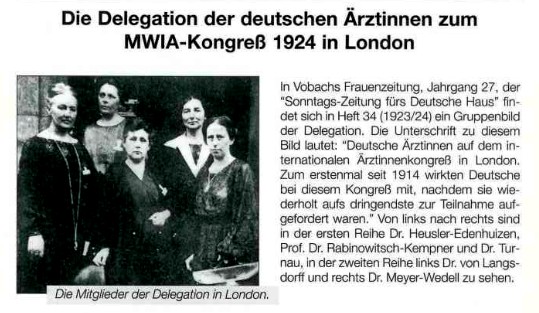
It was the struggles and experiences she endured during her own education that led her to campaign for women's rights until the end of her career. She was one of the founding members of the first professional association in Germany for women doctors. The Association of German Women Doctors (BDÄ), the predecessor of the German Medical Women's Association (DÄB), was established in Berlin in 1924 by von Langsdorrff together with the doctors Hermine Heusler-Edenhuizen (1872–1955) – the first gynecologist in Germany – Laura Turnau (1882–1978), Lilly Meyer-Wedell (1881–1944), and Dorothea Dietrich (1879–?). They were committed to supporting young women in order to spare them the painful path they themselves had had to take. The German Medical Women's Association refers to these women as the “giants” on whose shoulders today's women doctors stand and thanks to whose commitment women have achieved equality in the medical profession.
Von Langsdorff served for many years as treasurer on the board and committee of the BDÄ (now DÄB) for issues relating to the fight against sexually transmitted diseases.
As early as 1924, the Essen local group was formed on her initiative.
Von Langsdorff was also active at the international level: for the first time since 1914, women from Germany participated in the International Medical Women's Association (MWIA) Congress in London in 1924. Toni von Langsdorff was one of the delegates.
After 1933, she was a candidate for the National Socialist German Medical Association, approved by the Office for Public Health. Her house and thus also her practice were destroyed during World War II and rebuilt elsewhere. After the end of the war, she was elected to the board of the Rhineland Medical Association as someone who was not suspected of political involvement. She was also active as an elected member on the committees for specialist recognition and licensing. From 1946 onwards, she invited female doctors to regular meetings in her private apartment in Essen-Bredeney, offering her support to colleagues who experienced problems in setting up a practice or obtaining health insurance accreditation.
She played a decisive role in the reconstruction of the German Red Cross (DRK) as head and deputy chairwoman of women's work in the Essen district association. She held her seat on the board until 1967 and was made an honorary member in 1968.
From 1949 to 1952, she was also a member of the German Academic Women's Association and the Hartmannbund.
In 1961, Toni von Langsdorff was awarded the Federal Cross of Merit First Class for her tireless commitment to professional training and education.
Her colleagues in the medical profession and association work described her as a “determined woman with a certain uncompromising nature, a trait that enabled her to achieve her goals… She was known for her consistent attitude and was perhaps even… somewhat feared.”
These statements may reflect the arduous, difficult path strewn with obstacles and barriers that the young, talented, and education-hungry women of her generation had to take in order to achieve something that is taken for granted by many today: self-realization and self-empowerment. She was right to pass on her story to posterity in her old age.
Author's note: all quotes from Toni von Langsdorff are taken from her autobiography and the commemorative publication mentioned in the German version.
(Text from 2025; translated with DeepL.com; edited by Ramona Fararo, 2026.
Please consult the German version for additional information, pictures, sources, videos, and bibliography.)
Quotes
Slowly but surely, I established myself as a doctor among the population and can look back on my work up to the age of 80 with great satisfaction.
Links
Grokipedia: Toni von Langsdorff. Available online at https://grokipedia.com/page/toni_von_langsdorff, checked on 7/20/2026.
Literature & Sources
Hellstedt, Leone McGregor (Hg.) (1978): Women physicians of the world. Autobiographies of medical pioneers. Washington. Hemisphere Publ. Corp. ISBN 0-07-027954-3.
Ogilvie, Marilyn Bailey; Harvey, Joy Dorothy (2000): The biographical dictionary of women in science. Pioneering lives from ancient times to the mid-20th century. 2 Bände. New York. Routledge. ISBN 9780203801451.
If you hold the rights to one or more of the images on this page and object to its/their appearance here, please contact Fembio.